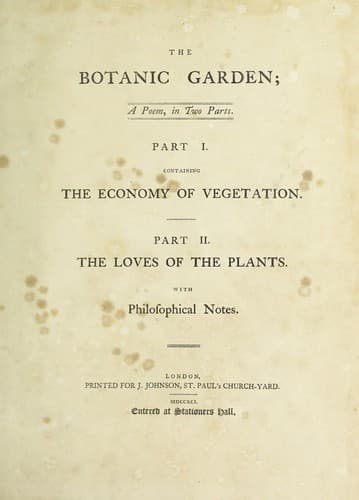
The Botanic Garden. Part 2, Containing the Loves of the Plants. A Poem.: With Philosophical Notes. — John Shaqi
The Botanic Garden. Part 2, Containing the Loves of the Plants. A Poem.: With Philosophical Notes.Darwin, Erasmus
History
The Botanic Garden. Part 2, Containing the Loves of the Plants. A Poem.: With Philosophical Notes.
Darwin, Erasmus
Natural history; Plants -- Poetry
Allegoric figures are on this account in general less manageable in
painting and in statuary than in poetry: and can seldom be introduced in
the two former arts in company with natural figures, as is evident
from the ridiculous effect of many of the paintings of Rubens in the
Luxemburgh gallery; and for this reason, because their improbability
becomes more striking, when there are the figures of real persons by
their side to compare them with. Mrs. Angelica Kauffman, well apprised of
this circumstance, has introduced no mortal figures amongst her Cupids
and her Graces. And the great Roubiliac, in his unrivalled monument of
Time and Fame struggling for the trophy of General Fleming, has only hung
up a medallion of the head of the hero of the piece. There are however
some allegoric figures, which we have so often heard described or seen
delineated, that we almost forget that they do not exist in common life;
and hence view them without astonishment; as the figures of the heathen
mythology, of angels, devils, death and time; and almost believe them
to be realities, even when they are mixed with representations of the
natural forms of man. Whence I conclude, that a certain degree of
probability is necessary to prevent us from revolting with distaste from
unnatural images; unless we are otherwise so much interested in the
contemplation of them as not to perceive their improbability.
_B_. Is this reasoning about degrees of probability just?--When Sir Joshua
Reynolds, who is unequalled both in the theory and practice of his art,
and who is a great master of the pen as well as the pencil, has asserted
in a discourse delivered to the Royal Academy, December 11, 1786, that
"the higher styles of painting, like the higher kinds of the Drama, do
not aim at any thing like deception; or have any expectation, that the
spectators should think the events there represented are really passing
before them." And he then accuses Mr. Fielding of bad judgment, when he
attempts to compliment Mr. Garrick in one of his novels, by introducing
an ignorant man, mistaking the representation of a scene in Hamlet for a
reality; and thinks, because he was an ignorant man, he was less liable
to make such a mistake.
_P_. It is a metaphysical question, and requires more attention than Sir
Joshua has bestowed upon it.--You will allow, that we are perfectly
deceived in our dreams; and that even in our waking reveries, we are
often so much absorbed in the contemplation of what passes in our
imaginations, that for a while we do not attend to the lapse of time or
to our own locality; and thus suffer a similar kind of deception as in
our dreams. That is, we believe things present before our eyes, which are
not so.
Public-domain text, read in full here on John Shaqi.
Reviews
Reviews
No reviews yet
Be the first to share your thoughts on this work.
Join the Discussion
Join the discussion
Sign in to leave a comment or review.
Sign InorCreate an account