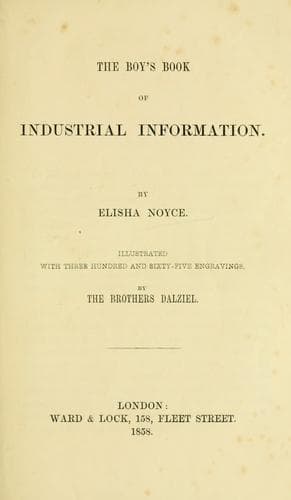
The Boy's Book of Industrial Information — John Shaqi
The Boy's Book of Industrial InformationNoyce, Elisha
General
The Boy's Book of Industrial Information
Noyce, Elisha
Industrial arts -- Juvenile literature; Technology -- Juvenile literature
Mercury, or quicksilver, is known from all other metals by being
fluid at the ordinary temperature of the air. This is only owing to
its extreme fusibility, for at 72 degrees below the freezing point
of water, it also becomes solid, and may be hammered out or cut by a
knife; it is very heavy, being about fifteen-and-a-half times that of
water, so that most of the metals will float on its surface; it has
a bright lustre and is almost as white as silver. It is found both in
the fluid metallic state, and in combination with sulphur, in which
last state it is called “cinnabar;” this is a heavy mass of a deep
red color, and when ground to powder, of a most magnificent red,
and is the vermillion so well known as a pigment; this vermillion is,
however, most frequently manufactured by combining the mercury and
sulphur, both first purified, in this way a more brilliant color is
produced than can be got from the cinnabar. The metal is extracted by
heating the cinnabar with iron-filings or lime in a retort, by which
means the mercury distils over and the sulphur is left behind united
with the iron or lime.
Mercury is used for many purposes in the arts and sciences, for
barometers, thermometers, compensating pendulums for clocks, &c., and
also in the processes of water-gilding, looking glass silvering, and
in the Daguerreotype process. The combinations of mercury with other
metals are called “amalgams.”
GOLD.
Illustration: GOLD (‡ NUGGET).
Gold is the heaviest of the metals with the exception of Platinum,
being rather more than nineteen times heavier than water; it is of
a bright yellow color, and is not tarnished by exposure to the air
or moisture, hence its usefulness in ornamenting frames, cornices,
&c. Gold is chiefly used, in the form of coin, as the medium of
exchange; for ornamental purposes, such as jewellery; for gilding,
and for staining glass, to which it gives a beautiful ruby-red color.
Gold coin contains about one twelfth part, by weight, of copper,
this is added to give it hardness and consequently cause it to lose
less by wear in use. Gold is not dissolved by any of the pure acids,
but a mixture of hydrochloric and nitric acids will dissolve it in
consequence of giving out chlorine, an element which freely dissolves
gold.
Gold is capable of being beaten out into leaves of extreme thinness,
and also of being drawn into wire of such thinness that five hundred
feet of it weigh but one grain.
SILVER.
Illustration: SILVER.
Public-domain text, read in full here on John Shaqi.
Reviews
Reviews
No reviews yet
Be the first to share your thoughts on this work.
Join the Discussion
Join the discussion
Sign in to leave a comment or review.
Sign InorCreate an account