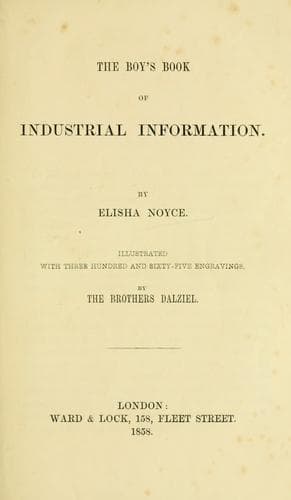
The Boy's Book of Industrial InformationNoyce, Elisha
General
The Boy's Book of Industrial Information
Noyce, Elisha
Industrial arts -- Juvenile literature; Technology -- Juvenile literature
Silver is the whitest of the metals; it is about ten-and-a-half
times heavier than water; it does not easily tarnish by the air,
and is not converted into dross by heat continued for any length of
time, or, in chemical language, it is not oxydised; it is chiefly
used for coin and for ornamental purposes where its cleanliness and
beauty are strong qualities to recommend it. Many kinds of lead ore
contain silver, and when this is in sufficiently large proportion to
pay for its extraction, the reduced lead is subjected to the flame
of a furnace which is blown on to it with a strong blast, the flame
melts the lead and converts it into an oxide called “litharge,”
which is in the form of reddish scales, and as these are formed the
blast blows them off; in this way the lead is gradually consumed,
leaving the silver with but a small quantity of lead, this is put on
to a cup made of bone ashes called a “cupel,” hence this operation
is called “cupellation,” the heat is then raised, and the lead
which remains with the silver, forming a liquid glass with the bone
ashes, sinks into them, leaving the silver bright and pure. Silver
in some districts is extracted from its ores by what is called
“amalgamation;” the finely powdered ore is mixed with water, some
cuttings of iron and quicksilver, and turned round in a barrel for a
considerable time, when the quicksilver is drawn off through a small
hole, and is found to contain all the silver in the ore, together
with some other metals. The quicksilver is got rid of, first by
pressing and then by distillation; so that it is all recovered for
a second operation. What remains is separated from the other metals,
which it may have been mixed with by different processes, according
to the nature of these metals.
The standard silver of the Mint is what is called 22 carats fine
(nearly), that is to say, 22 parts in 24, the two parts being copper;
this is done to harden it. The silvering of looking-glasses is made
of a compound of tin and mercury, but a process for really silvering
looking-glasses has been patented by Mr. Drayton; it consists of
precipitating silver from its solution by means of the oil of Cassia,
or some other volatile oil: the process is far too expensive for
general use or for large plates. Silver leaf is made and used in the
same way that gold leaf is.
PLATINUM.
Public-domain text, read in full here on John Shaqi.
Reviews
Reviews
No reviews yet
Be the first to share your thoughts on this work.
Join the Discussion
Join the discussion
Sign in to leave a comment or review.
Sign InorCreate an account