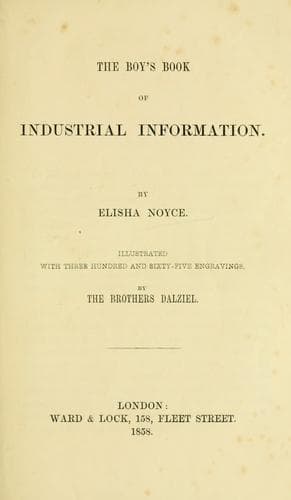
The Boy's Book of Industrial Information — John Shaqi
The Boy's Book of Industrial InformationNoyce, Elisha
General
The Boy's Book of Industrial Information
Noyce, Elisha
Industrial arts -- Juvenile literature; Technology -- Juvenile literature
wooden shovels and placed in conical vessels with a hole in their
lower part to drain off all the moisture; it is then dried by stoves
and is fit for use; when no more salt falls down, the impure liquor,
called “bittern,” is drawn off and used to procure Epsom salts from,
by mixing it with sulphuric acid. The bittern contains chloride
of magnesium, and the sulphuric acid changes it into sulphate
of magnesia, which, when purified, forms the Epsom salts sold by
druggists.
About half a million tons of salt are made in England every year.
Salt, besides its general use as a condiment, and in preserving
food for storing ships, &c., is also used for several manufacturing
purposes. By adding sulphuric acid and heating it, the acid called
“hydrochloric” is given off, which is largely used for many purposes;
but the chief use made of salt by the manufacturing chemist is to
prepare soda for cleansing and soap making.
STONE.
Illustration: STONE QUARRY.
Stone for building is chiefly of four kinds:--lime-stone, sand-stone,
granite, and marble. Slate is never used for building, but is very
suitable for roofing. The most common stone is limestone, and that
brought from Portland Island is especially good for building-stone;
it is called Portland stone, and it is of this stone that St. Paul’s
Cathedral is built, and most of the other public buildings of London:
it is rather soft when first dug from the quarry, but hardens with
age. Sandstone is a very coarse kind of stone, and is only used
where not much exposed to the weather; it consists of grains of
sand adhering so firmly together as to form a stone of considerable
hardness. Granite is a very hard stone, and very durable; so hard
that it cannot well be carved, and is therefore only used where
durability and plain solidity are required; London Bridge and the
Euston Square Terminus of the Birmingham Railway are built of
granite. Marble is a very fine heavy kind of limestone, sometimes
quite white, and generally partly transparent; the white kind is
very expensive, and is used for statuary, that is to say, for carving
into figures, vases, &c.; it is very durable, but is too expensive
for general use. Chimney-pieces, slabs for washing-stands, and other
articles of that description, are also made of it.
Limestone, marble, and also chalk (a soft kind of limestone), all
become changed into lime if made red hot, hence the name, limestone,
is often applied to all three.
Public-domain text, read in full here on John Shaqi.
Reviews
Reviews
No reviews yet
Be the first to share your thoughts on this work.
Join the Discussion
Join the discussion
Sign in to leave a comment or review.
Sign InorCreate an account