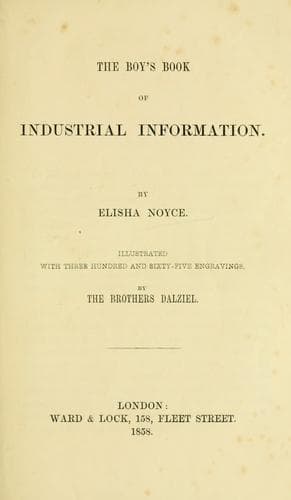
The Boy's Book of Industrial InformationNoyce, Elisha
General
The Boy's Book of Industrial Information
Noyce, Elisha
Industrial arts -- Juvenile literature; Technology -- Juvenile literature
Stone quarries are those places where stone exists of a quality
suitable for building purposes, and in a situation admitting of its
easy removal. All stone, with the exception of granite and marble,
exists in layers or strata as they are called, so that the stone
can be easily split in the direction of these strata or seams. When
a large piece of stone has to be removed, wedges are driven in a
row into these seams, and when the stone has started, it is notched
at the sides and back, so that in general a square piece is thus
removed; if it be not so, it is generally made into a somewhat square
before leaving the quarry, hence the name, derived from the French
“_quarre_.” Granite having none of the lines of cleavage, as they
are called, is broken by a row of wedges driven till a crack forms
from one to the other. Slate is a clay-stone found in layers like
limestone, but much more perfect; so much so, indeed, that it can
be split into slices a quarter of an inch thick and one or two feet
square; these, when sorted into sizes, form the slates for roofing
houses. It has been much used of late in thick slabs, cut by circular
saws, for making cisterns, a purpose for which it is well adapted.
WOOD.
Illustration: (‡ LOGGERS.)
Wood is an article of universal application; its lightness, strength,
and the facility with which it can be worked, render it almost
invaluable; although in ship-building and many of its applications
to house-building iron has to some extent superseded it, yet there
are so many other ways in which it is indispensable, that it may
be looked upon as one of the greatest boons to mankind. There is
scarcely a use to which wood may not be applied, whether as fuel
for fires, timber for building, furniture both useful and ornamental,
various parts of machinery, vessels to contain wine and other fluids,
handles to instruments, (for in cold climates and cold weather metal
cannot be handled with impunity), and indeed for all uses in which
lightness, dryness, warmth, and variety of form are desirable, wood
serves as an excellent material. The kind of trees that produce wood
fit for building and other useful purposes are those called by the
botanists _exogenous_. Amongst which the pine tribe, oak, ash, elm,
and beech, stand pre-eminent; while mahogany, walnut, and rosewood
are chiefly used for ornamental purposes; box-tree wood is also very
useful on account of its closeness and evenness of grain; it is the
wood used by engravers.
Public-domain text, read in full here on John Shaqi.
Reviews
Reviews
No reviews yet
Be the first to share your thoughts on this work.
Join the Discussion
Join the discussion
Sign in to leave a comment or review.
Sign InorCreate an account