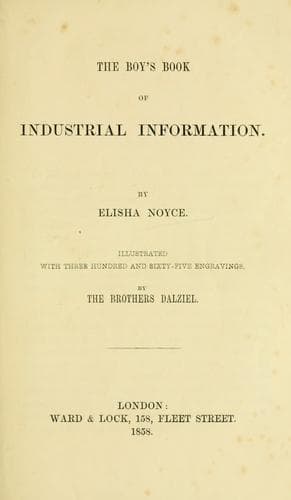
The Boy's Book of Industrial Information — John Shaqi
The Boy's Book of Industrial InformationNoyce, Elisha
General
The Boy's Book of Industrial Information
Noyce, Elisha
Industrial arts -- Juvenile literature; Technology -- Juvenile literature
Wood when first cut is wet and heavy, but, by being exposed to the
air, it shrinks and the sap dries up in it, it is therefore liable to
swell and become damp in moist situations this is detrimental to its
usefulness; most woods therefore are improved by being soaked a long
time in water, this cleanses it from saline and extractive matters
which keeps the wood damp, but which, when separated, allow the wood
to shrink and harden permanently, this process is called seasoning,
the same effect may be produced by exposure to the air and rain,
it is generally resorted to when the timber is cut up into smaller
pieces. The structure of wood is porous, hence its lightness, it has
also a grain which runs the whole length of the wood in circles round
its centre to the surface, one of these circles is produced every
year while the tree is growing; wood is therefore capable of being
cleft in the direction of the grain by a wedge, in this way builder’s
laths are made. Wood cannot be cleft across the grain, but must be
cut by sawing or otherwise. The pine or fir tribe produce the largest
and straightest timber, but it is not so strong nor so durable as oak
and many other woods.
Some specimens of the _Araucaria Excelsa_ or Norfolk Island pine,
have stems upwards of three hundred feet high, and in the Crystal
Palace is the bark of another gigantic tree the _Wellingtonia
Gigantea_.
COTTON.
Illustration: COTTON (‡ PLANT).
Cotton consists of the fine long hairs which grow from the seeds of
several varieties of _Gossypium_, a plant belonging to the natural
order of _Malvaceæ_. These hairs are so long and numerous that they
completely fill the pod or seed vessel; they are very delicate, and
of the same size throughout, and but seldom jointed, they are each
separate from the other.
The cotton plant is chiefly cultivated in America and India. In
India, and some of the islands in the Indian Ocean, cotton has
been cultivated, spun, and woven into textures from time immemorial.
Cotton fabrics were in use in Mexico before its conquest by the
Spaniards, and have been used in China for many hundred years; its
chief source now is America, where more than two hundred times the
quantity is grown at present than was grown there half-a-century ago;
but the internal communication brought about by railways in India,
may, in all probability, revive the cultivation of cotton in that
country; the cost of conveyance from the interior having been one of
the greatest drawbacks to its exportation.
Public-domain text, read in full here on John Shaqi.
Reviews
Reviews
No reviews yet
Be the first to share your thoughts on this work.
Join the Discussion
Join the discussion
Sign in to leave a comment or review.
Sign InorCreate an account