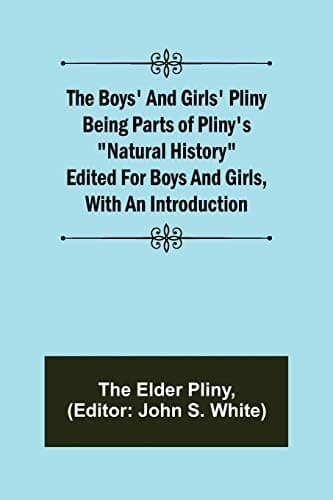
The Boys' and Girls' Pliny: Being parts of Pliny's "Natural History" edited for boys and girls, with an IntroductionPliny, the Elder
History
The Boys' and Girls' Pliny: Being parts of Pliny's "Natural History" edited for boys and girls, with an Introduction
Pliny, the Elder
Animals -- Juvenile literature; Natural history -- Juvenile literature; Physical sciences -- Juvenile literature
But, although I have laid aside my blushes, I have not gained my object;
for you still awe me, and keep me at a distance, by the majesty of your
understanding. In no one does the force of eloquence and of tribunitian
oratory blaze out more powerfully! With what glowing language you
thunder forth the praises of your Father! How dearly you love your
Brother! How admirable is your talent for poetry! What a fertility of
genius you possess, so as to enable you to imitate your Brother! But who
is there that is bold enough to form an estimate on these points, if he
is to be judged by you, and, more especially, if you are challenged to
do so? For the case of those who merely publish their works is very
different from that of those who expressly dedicate them to you. In the
former case I might say, Emperor! why do you read these things? They are
written only for the common people, for farmers or mechanics, or for
those who have nothing else to do; why do you trouble yourself with
them? Indeed, when I undertook this work, I did not expect that you
would sit in judgment upon me; I considered your situation much too
elevated for you to descend to such an office. Besides, we possess the
right of openly rejecting the opinion of men of learning. Marcus Tullius
Cicero himself, whose genius is beyond all competition, uses this
privilege; and, remarkable as it may appear, employs an advocate in his
own defence:—“I do not write for very learned people; I do not wish my
works to be read by Manius Persius, but by Junius Congus.” And if
Lucilius, who first introduced the satirical style, applied such a
remark to himself, and if Cicero thought proper to borrow it, and that
more especially in his treatise “De Republica,” how much reason have I
to do so, who have such a judge to defend myself against! And by this
dedication I have deprived myself of the benefit of challenge; for it is
a very different thing whether a person has a judge given him by lot, or
whether he voluntarily selects one; and we always make more preparation
for an invited guest, than for one that comes in unexpectedly.
Public-domain text, read in full here on John Shaqi.
Reviews
Reviews
No reviews yet
Be the first to share your thoughts on this work.
Join the Discussion
Join the discussion
Sign in to leave a comment or review.
Sign InorCreate an account