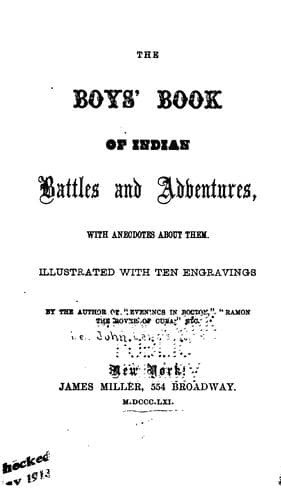
The boys' book of Indian battles and adventures, with anecdotes about them
History
The boys' book of Indian battles and adventures, with anecdotes about them
Indians of North America -- Anecdotes
[Illustration: INDIAN MAIDEN.]
THE
BOYS’ BOOK
OF
INDIAN
Battles and Adventures.
[Illustration]
New York:
JAMES MILLER.
THE
BOYS’ BOOK
OF INDIAN
Battles and Adventures,
WITH ANECDOTES ABOUT THEM.
ILLUSTRATED WITH TEN ENGRAVINGS
BY THE AUTHOR OF “EVENINGS IN BOSTON,” “RAMON
THE ROVER OF CUBA,” ETC.
New York:
JAMES MILLER, 522 BROADWAY.
M.DCCC.LXVI.
Entered, according to Act of Congress, in the year 1860, by
JAMES MILLER,
in the Clerk’s office of the District Court of the United States, for the
Southern District of New York.
PREFACE.
The character of the aboriginal inhabitants of the western continent is
in many respects remarkable and striking. It possesses great interest
for the student of history as well as the observer of human nature.
Still this character has never been properly exhibited in a connected
view. One is obliged to detect the traits in detached incidents and
scattered descriptions; and thus by a sort of inductive process to
determine the real disposition, powers and capabilities of the North
American Savage. It is for the purpose of bringing the materials of this
inductive process within the compass of a single volume of moderate size
that these “Anecdotes” have been collected. They present the savage in
all his various aspects and relations, in all circumstances of sorrow
and joy, danger, difficulty and triumph. The incidents here narrated,
while they exhibit the most prominent traits of the Indian character,
also bring into view the most striking passages of our national history
in its connection with the aborigines, and thus serve a double purpose
as an exercise in historical as well as philosophical study. Its chief
object is utility. Its particular design is to subserve the great cause
of national education.
NEW YORK, _Oct. 1st, 1860_.
INDIAN BATTLES AND ADVENTURES.
INDIAN HONESTY.
In the character of the Indians of North America there are many traits
which their white neighbours would do well to imitate. Among these,
strict honesty is one. Mr. Catlin gives the credit of this virtue to
all the wild tribes which he visited, not corrupted by intercourse with
civilized nations. Bolts and bars, for the protection of property, among
them are unknown. He cites many examples to prove this. The following
anecdote is from another source.
Public-domain text, read in full here on John Shaqi.
Reviews
Reviews
No reviews yet
Be the first to share your thoughts on this work.
Join the Discussion
Join the discussion
Sign in to leave a comment or review.
Sign InorCreate an account