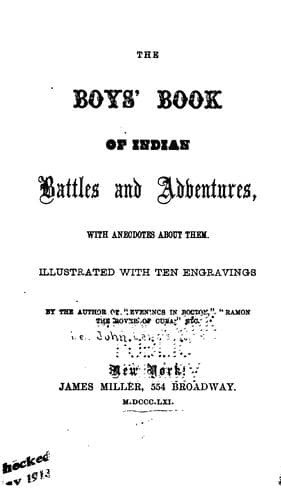
The boys' book of Indian battles and adventures, with anecdotes about them
History
The boys' book of Indian battles and adventures, with anecdotes about them
Indians of North America -- Anecdotes
Of all the vices incident to the aborigines of this country, from their
intercourse with the whites, that of lying is, probably, not among the
least. Some years anterior to the independence of the United States,
one Tom Hyde, an Indian famous for his cunning, went into a tavern in
Brookfield, Massachusetts, and after a little chat told the landlord he
had been hunting, and had killed a fine fat deer, and if he would give
him a quart of rum he would tell him where it was. Mine host, unwilling
to let slip so good an opportunity of obtaining venison, immediately
struck the bargain and measured the Indian his quart of rum, at the same
time asking where the deer was to be found. ‘Well,’ says Tom, ‘do you
know where the great meadow is?’ ‘Yes.’ ‘Well, do you know the great
marked maple tree that stands in it?’ ‘Yes.’ ‘Well, there lies the deer.’
Away posted the landlord with his team, in quest of his purchase. He
found the meadow and the tree, it is true; but all his searching after
the deer was fruitless, and he returned home no heavier than he went,
except in mortification and disappointment. Some days after, mine host
met the Indian, and feeling indignant at the deception practised on him,
accused him in no gentle terms of the trick. Tom heard him out—and, with
the coolness of a stoic, replied—‘Did you not find the meadow, as I
said?’ ‘Yes.’ ‘And the tree?’ ‘Yes.’ ‘And the deer?’ ‘No.’ ‘Very good,’
continued he, ‘you found _two truths for one lie, which is very well for
an Indian_.’
CANONICUS.
Mr. Drake, in his Book of the Indians, thus mentions Canonicus, the
sachem of the Narragansets:—
He was contemporary with Miantunnomoh, who was his nephew. We know not
the time of his birth, but a son of his was at Boston in 1631, the next
year after it was settled. But the time of his death is minutely recorded
by Governor Winthrop, in his “Journal,” thus: “June 4, 1647, Canonicus,
the great sachem of Narraganset, died, a very old man.” He is generally
supposed to have been about 85 years of age when he died.
He is mentioned with great respect by Rev. Roger Williams, in the year
1654. After observing that many hundreds of the English were witnesses
to the friendly disposition of the Narragansets, he says, “their late
famous long-lived Canonicus so lived and died, and in the same most
honourable manner and solemnity, (in their way,) as you laid to sleep
your prudent peace-maker, Mr. Winthrop, did they honour this their
prudent and peaceable prince; yea, through all their towns and countries
how frequently do many, and oft times our Englishmen, travel alone with
safety and loving kindness?”
ESQUIMAUX INDIANS.
Captain Ross, in the Journal of his Arctic Expedition,
gives the following account of his first interview with the
Esquimaux, in the northern parts of Baffin’s Bay:
Public-domain text, read in full here on John Shaqi.
Reviews
Reviews
No reviews yet
Be the first to share your thoughts on this work.
Join the Discussion
Join the discussion
Sign in to leave a comment or review.
Sign InorCreate an account