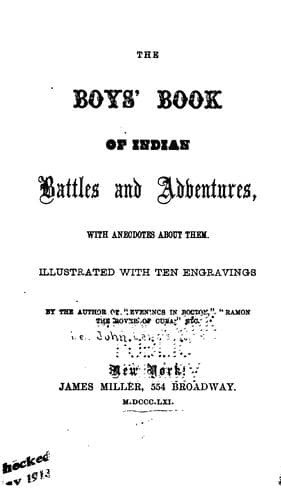
The boys' book of Indian battles and adventures, with anecdotes about them — John Shaqi
The boys' book of Indian battles and adventures, with anecdotes about them
History
The boys' book of Indian battles and adventures, with anecdotes about them
Indians of North America -- Anecdotes
This celebrated Indian chief, who had always been a zealous friend of
the English, and had often distinguished himself in their service, was
taken prisoner, and brought before the General Assembly of Virginia,
who hesitated whether he should be tried by court martial as a soldier,
or at the criminal bar for high treason. Logan stated that they had
no jurisdiction to try him; that he owed no allegiance to the King of
England, being an Indian Chief, independent of every nation. In answer to
their inquiries as to his motives for taking up arms against the English,
he thus addressed the Assembly. “I appeal to any white man, to say if
ever he entered Logan’s cabin hungry, and I gave him not meat; if ever he
came cold or naked, and I gave him not clothing. During the last long and
bloody war, Logan remained idle in his tent, an advocate for peace; nay
such was my love for the whites, that those of my country pointed at me,
as they passed by, and said, ‘Logan is the friend of white men.’ I had
ever thought to live with you but for the injuries of one man. Colonel
Cressap, the last spring, in cold blood, and unprovoked, cut off all the
relations of Logan, not sparing even my women and children. There runs
not a drop of my blood in the veins of any human creature. This called
on me for revenge. I have sought it. I have killed many. I have fully
glutted my vengeance. For my country, I rejoice at the beams of peace.
But do not harbor the thought that mine is the joy of fear. Logan never
felt fear. He will not turn his heel to save his life. Who is there to
mourn for Logan? Not one!”
This pathetic speech touched the sensibility of all who heard it. The
General Assembly applauded his noble sentiments, and immediately set him
at liberty. The inhabitants of Virginia vied with each other who should
entertain him the best, or show him the greatest respect; and he returned
to his native country loaded with presents and honors.
THE INDIAN’S VIEWS OF THE TRINITY.
Elliot had been lecturing on the doctrine of the trinity, when one of
his auditors, after a long and thoughtful pause, thus addressed him. ‘I
believe, Mr. Minister, I understand you. The trinity is just like water
and ice and snow. The water is one, the ice is another, and the snow is
another; and yet they are all one water.’
MORE ROOM.
When General Lincoln went to make peace with the Creek Indians, one of
the chiefs asked him to sit down on a log; he was then desired to move,
and in a few minutes to move still farther; the request was repeated till
the General got to the end of the log. The Indian said, ‘Move farther.’
To which the General replied, ‘I can move no farther.’ ‘Just so it is
with us,’ said the chief; ‘you have moved us back to the water, and then
ask us to move farther.’
INDIAN MENDACITY.
Public-domain text, read in full here on John Shaqi.
Reviews
Reviews
No reviews yet
Be the first to share your thoughts on this work.
Join the Discussion
Join the discussion
Sign in to leave a comment or review.
Sign InorCreate an account