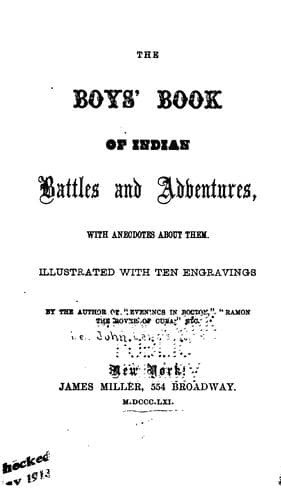
The boys' book of Indian battles and adventures, with anecdotes about them
History
The boys' book of Indian battles and adventures, with anecdotes about them
Indians of North America -- Anecdotes
It happened during the Revolutionary war, that a treaty was held with the
Indians, at which La Fayette was present. The object was to unite the
various tribes in amity with America. The majority of the Chiefs were
friendly, but there was much opposition made to it, more especially by a
young warrior, who declared that when an alliance was entered into with
America, he should consider the sun of his country as set forever. In his
travels through the Indian country, when lately in America, it happened
at a large assemblage of Chiefs, that La Fayette referred to the treaty
in question, and turning to Red Jacket, said, “pray tell me if you can,
what has become of that daring youth, who so decidedly opposed all our
propositions for peace and amity? Does he still live—and what is his
condition?” “I, myself, am the man,” replied Red Jacket, “the decided
enemy of the Americans, as long as the hope of opposing them with success
remained but now their true and faithful ally until death.”
INDIAN MODE OF GETTING A WIFE.
An aged Indian, who for many years had spent much of his time among
the white people both in Pennsylvania and New Jersey, one day, about
the year 1770, observed, that the Indians had not only a much easier
way of getting a wife than the whites, but were also more certain of
getting a _good_ one; ‘for’ (said he in his broken English) ‘white man
court—court—may be one whole year!—may be two before he marry!—well!—may
be then get _very good_ wife—but, may be _not_—may be _very_ cross! Well
now, suppose cross! Scold so soon at get awake in the morning! Scold
all day! Scold until sleep!—all one; he must keep _him_! White people
have law forbidding throwing away wife, be _he_ ever so cross! must keep
_him_ always! Well? how does Indian do? Indian when he see industrious
squaw, which he like, he go to _him_, place his two fore-fingers close
aside each other, make two look like one—look squaw in the face—see _him_
smile—which is all one _he_ say, yes! so he take _him_ home—no danger
_he_ be cross! no! no! Squaw know too well what Indian do if _he_ be
cross!—throw _him_ away and take another! Squaw love to eat meat! no
husband! no meat! Squaw do every thing to please husband; he do the same
to please squaw! live happy!’
[Illustration]
SHENANDOH, THE ONEIDA CHIEF.
Although the dignity of a chief is hereditary in his family, generally,
the aristocracy of the Indians is not one of birth merely, nor one of
wealth; but it is an aristocracy of merit. A chief is liable to be
deposed for misconduct; and a brave warrior takes his place on account
of the actions he has performed. Among those who have maintained an
ascendancy among their countrymen by the force of individual merit, none
is more remarkable than Shenandoh, the Oneida chief.
Public-domain text, read in full here on John Shaqi.
Reviews
Reviews
No reviews yet
Be the first to share your thoughts on this work.
Join the Discussion
Join the discussion
Sign in to leave a comment or review.
Sign InorCreate an account