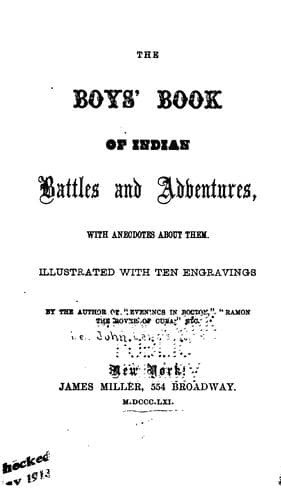
The boys' book of Indian battles and adventures, with anecdotes about them
History
The boys' book of Indian battles and adventures, with anecdotes about them
Indians of North America -- Anecdotes
This celebrated chief, whose life measured a century, died in 1816.
He was well known in the wars which occurred while the United States
were British colonies; and, also, in the war of the Revolution—as the
undeviating friend of the Americans.
In his youth he was very savage, and addicted to drunkenness; but, by the
force of reflection, and the benevolent exhortations of a missionary to
the tribe, he lived a reformed man for more than sixty years, and died in
Christian hope.[5]
Shenandoh’s person was tall and muscular but well made—his countenance
was intelligent, and beamed with all the ingenuous dignity of an Indian
Chief. In youth, he was brave and intrepid—in his riper years, one of
the ablest counsellors among the North American tribes. He possessed a
strong and vigorous mind; and, though terrible as the tornado in war—he
was bland and mild as the zephyr in peace. With the cunning of the fox,
the hungry perseverance of the wolf, and the agility of the mountain cat,
he watched and repelled Canadian invasions. His vigilance once preserved
from massacre the inhabitants of the then infant settlements of the
German Flats. His influence brought his tribe to assist the Americans, in
their war of the Revolution. His many friendly actions in their behalf,
gained for him, among the Indian tribes, the appellation of the ‘_White
Man’s Friend_.’
To a friend who called to see him, in his wane (he was then blind), he
thus expressed himself:
“I am an aged hemlock—the winds of a hundred winters have whistled
through my branches—I am dead at the top. The generation to which I
belonged have run away and left me. Why _I_ live, the Great Spirit alone
knows! Pray to my Jesus that I may have patience to wait for my appointed
time to die.”
‘Indulge my native land; indulge the tear
That steals impassioned o’er the nation’s doom:
To me each twig from Adam’s stock is near,
And sorrows fall upon an Indian’s tomb.’
INDIAN GRATITUDE AND WIT.
Public-domain text, read in full here on John Shaqi.
Reviews
Reviews
No reviews yet
Be the first to share your thoughts on this work.
Join the Discussion
Join the discussion
Sign in to leave a comment or review.
Sign InorCreate an account