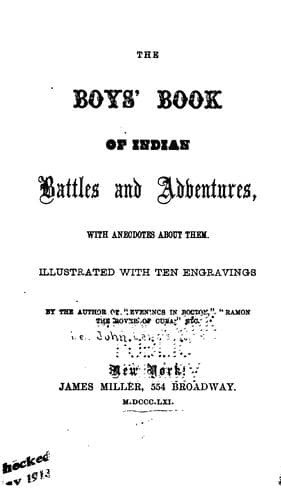
The boys' book of Indian battles and adventures, with anecdotes about them
History
The boys' book of Indian battles and adventures, with anecdotes about them
Indians of North America -- Anecdotes
“An instance of this occurred,” says Bossu, “when the French were in
possession of New Orleans: a Chactaw, speaking very ill of them, said
the Collapissas were their slaves; one of the latter, vexed at such
words, killed him with his gun. The nation of Chactaws, the greatest and
most numerous on the continent, armed immediately, and sent deputies to
New Orleans to ask for the head of the murderer, who had put himself
under the protection of the French. They offered presents to make up the
quarrel, but the cruel people would not accept any! they even threatened
to destroy the village of the Collapissas. To prevent the effusion of
blood, the unhappy Indian was delivered up to them: the Sieur Ferrand
was charged with the commission. The Indian was called Tichou; he stood
upright in the midst of his own people and of his enemies, and said,
“I am a true man, that is, I do not fear death; but I pity the fate of
a wife and four children, whom I leave behind me very young; and of
my father and mother, who are old, and for whom I got subsistence by
hunting.” (He was the best hunter in the nation.)
He had hardly spoken the last word of this short speech, when his father,
penetrated with his son’s love, rose amidst the people, and spoke as
follows:—
“It is through courage that my son dies; but, being young and full of
vigour, he is more fit than myself to provide for his mother, wife, and
four little children: it is therefore necessary he should stay on earth
to take care of them. As to myself, I am near the end of my career; I am
no longer fit for anything: I cannot go like the roebuck, whose course
is like the winds, unseen; I cannot sleep like the hare, with my ears
never shut; but I have lived as a man, and will die as such, therefore I
go to take his place.”
At these words, his wife, his son, his daughter-in-law, and their little
children, shed tears round the brave old man: he embraced them for the
last time. The relations of the dead Chactaw accepted the offer; after
that, he laid himself on the trunk of a tree, and his head was cut off
with one stroke of a hatchet. Every thing was made up by this death; but
the young man was obliged to give them his father’s head: in taking it
up, he said to it, “Pardon me thy death, and remember me in the country
of spirits.”
Public-domain text, read in full here on John Shaqi.
Reviews
Reviews
No reviews yet
Be the first to share your thoughts on this work.
Join the Discussion
Join the discussion
Sign in to leave a comment or review.
Sign InorCreate an account