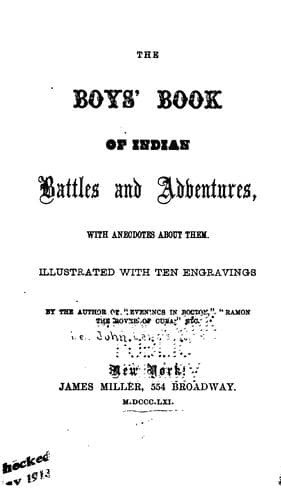
The boys' book of Indian battles and adventures, with anecdotes about them
History
The boys' book of Indian battles and adventures, with anecdotes about them
Indians of North America -- Anecdotes
All the French who assisted at this event were moved even to tears, and
admired this noble old man. A people among whom such things could be
done, hardly deserved the sweeping censures of Mather and other good
men, who painted them rather as fiends in human shape. Courage is, of
course, the virtue held in most honour: those who run away or desert in
an action are not punished, they are considered as the disgrace of human
nature: the ugliest girls will not accept of them for husbands: they are
obliged to let their hair grow, and to wear an alcoman, or apron, like
the women. “I saw one of them,” says Bossu, who dwelt a long time among
the Indians “who, being ashamed of his figure, went by himself to fight
the Chicachas, for his misery was more than he could bear: for three or
four days he went on creeping like a snake, and hiding himself in the
great grass, without eating or drinking; so he came to their country, and
watched a long time to do some exploit; often lying down in the rushes,
when his enemies came near, and putting out his head above the water
from time to time, to take breath. At last he drew near a village in the
night, cried the cry of death, killed one of the people, and then fled
with the speed of an arrow. He was out three months upon this expedition:
when he drew nigh to his own village, weary, and bearing the head of his
enemy, they came down the hill to meet him. The women were loud in his
praises—the warriors gathered round him; and then they gave him a wife.”
JOHN ELIOT’S FIRST MISSION TO THE INDIANS.
On the 28th of October, 1646, Eliot set out from his home, in Roxbury,
Massachusetts, in company with three friends, to the nearest Indian
settlement: he had previously sent to give this tribe notice of his
coming, and a very large number was collected from all quarters. If
the savages expected the coming of their guest, of whose name they had
often heard, to be like that of a warrior or sachem, they were greatly
deceived. They saw Eliot on foot, drawing near, with his companions;
his translation of the scriptures, like a calumet of peace and love, in
his hand. He was met by their chief, Waubon who conducted him to a large
wigwam. After a short rest, Eliot went into the open air and standing on
a grassy mound, while the people formed around him in all the stillness
of strong surprise and curiosity, he prayed in the English tongue, as if
he could not address heaven in a language both strange and new. And then
he preached for an hour in their own tongue, and gave a clear and simple
account of the religion of Christ, of his character and life, of the
blessed state of those who believed in him.
Public-domain text, read in full here on John Shaqi.
Reviews
Reviews
No reviews yet
Be the first to share your thoughts on this work.
Join the Discussion
Join the discussion
Sign in to leave a comment or review.
Sign InorCreate an account