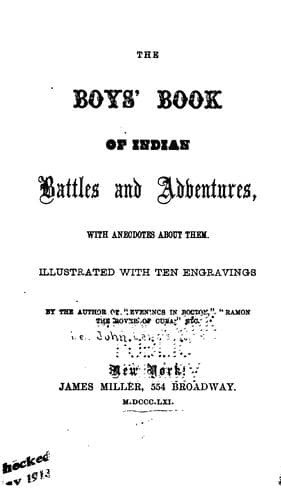
The boys' book of Indian battles and adventures, with anecdotes about them
History
The boys' book of Indian battles and adventures, with anecdotes about them
Indians of North America -- Anecdotes
The ground of the town having been marked out, Eliot advised the Indians
to surround it with ditches and a stone wall; gave them instruments
to aid these objects, and such rewards, in money, as induced them to
work hard. It was a strange and novel thing to see these men of the
wilderness, to whom a few months previous all restraint was slavery,
and their lakes and forests dearer than the palaces of kings, submit
cheerfully to this drudgery of bricks and mortar—chief as well as serf;
the very hands that were lately red with slaughter, scooping the earth
at the bidding of Eliot, from morn to night. He soon had the pleasure of
seeing Nonanetum completed.
The progress of civilization which followed, was remarkable for its
extent and rapidity: the women were taught to spin, and they soon found
something to send to the nearest markets all the year round: in winter
they sold staves, baskets, and poultry; in spring and summer fish,
grapes, strawberries, &c.
In the mean while, he instructed the men in husbandry, and the more
simple mechanical arts: in hay-time and harvest, he went forth into the
fields with them. All this was not done in a day, for they were neither
so industrious nor so capable of hard labour as those who had been
accustomed to it from early life.
AN INDIAN FUNERAL AT NONANETUM.
At a funeral, on the 7th of October, 1647, a change in the usages and
prejudices of the Indians was evinced in a striking manner. The deceased
was a man of some consequence. Their custom had been to mourn much for
the dead, and to appear overcome with grief, especially when the earth
shrouded them from their sight. The departed was borne to the grave on
a light bier, and interred in a sitting posture; in his hand was placed
a calumet and some tobacco, that he might present the ensigns of peace
to the people of another world. If the corpse was that of a warrior, his
quiver full of arrows, a bow, and a hatchet, were placed by his side,
and also a little mirror, that he might see how his face looked after
passing through the region of death; and a little vermilion to take
away its extreme paleness. His was a bold hand that could at once tear
aside these loved usages, and make the dust of the warrior of no more
consequence than that of the meanest of his followers. The cemetery of
the new town was in the woods, and the procession of all the inhabitants
moved slowly beneath their shadow, in deep and solemn silence, with the
missionary at their head: no wail was heard—no wild gush of sorrow. To
estimate this sacrifice, it is necessary to recur to the Indian belief,
“that after death they should go to a very fertile country, where they
were to have many wives, and, above all, lovely places for hunting:”
often, no doubt, the shadowy chase of the bear and the stag came on the
dreams of the dying man; and afterwards, beautiful women would welcome
him, weary to his home. When the dead was laid in the grave, Eliot read
Public-domain text, read in full here on John Shaqi.
Reviews
Reviews
No reviews yet
Be the first to share your thoughts on this work.
Join the Discussion
Join the discussion
Sign in to leave a comment or review.
Sign InorCreate an account