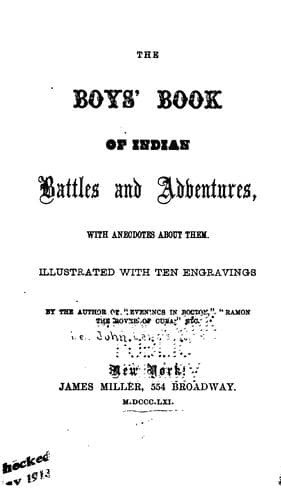
The boys' book of Indian battles and adventures, with anecdotes about them
History
The boys' book of Indian battles and adventures, with anecdotes about them
Indians of North America -- Anecdotes
On the night after this third meeting, many were gathered in the tent,
looking earnestly at Eliot, with the solemn gravity and stillness which
these savages affected; when the chief, Waubon, suddenly rose, and began
to instruct all the company out of the things he had heard that day from
Eliot, with the wild and impressive eloquence of the desert. And waking
often that night, he many times was heard speaking to some or other of
his people, of the words of truth and mercy that he had heard.
Two or three days after these impressions had been made, Eliot saw that
they were likely to be attended with permanent consequences. Wampas,
an intelligent Indian, came with two of his companions to the English,
and desired to be admitted into their families. He brought his son, and
several other children with him, and begged that they might be educated
in the Christian faith: the example quickly spread and all the Indians
who were present at the fourth meeting, on the 9th of December, offered
their children to be instructed.
The missionary was himself surprised at the success of his first efforts,
as well as at his facility of preaching and conversing in the Indian
tongue; it was the reward of his long and patient application. “To think
of raising,” says Mather, “these hideous creatures unto the elevations
of our holy religion, must argue a more than common or little soul
in the undertaker: could he see any thing angelical to encourage his
labours?—all was diabolical among them.”
Eliot saw that they must be civilized ere they could be christianized;
that he must make men of them, ere he could hope to see them saints. It
is, no doubt, far easier and more flattering to the soul of the agent, to
see men weep and tremble beneath his word, than to teach them to build,
to plant, to rear the walls and the roof-tree, and sit at their own
hearth-side: this is slow and painful work for a man of lofty mind and
glowing enthusiasm. But in his own words, “he abhorred that he should sit
still, and let that work alone;” and lost no time in addressing himself
to the General Court of the colony, in behalf of those who showed a
willingness to be placed under his care. His application was successful;
and the Indians, having received a grant of land on which they might
build a town, and enjoy the Christian instruction which they desired, met
together, and gave their assent to several laws which he had framed, to
enforce industry and decency—to secure personal and domestic comfort.
Public-domain text, read in full here on John Shaqi.
Reviews
Reviews
No reviews yet
Be the first to share your thoughts on this work.
Join the Discussion
Join the discussion
Sign in to leave a comment or review.
Sign InorCreate an account