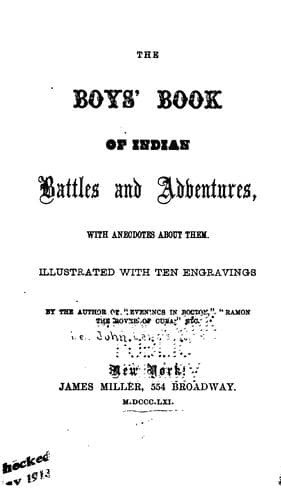
The boys' book of Indian battles and adventures, with anecdotes about them — John Shaqi
The boys' book of Indian battles and adventures, with anecdotes about them
History
The boys' book of Indian battles and adventures, with anecdotes about them
Indians of North America -- Anecdotes
Moved by these words, a noble woman came to join herself to the favourite
wife, of her own accord, being engaged, she said, by the friendship she
bore the Stung Serpent, to follow him into the other world. The Europeans
called her the Haughty Lady, on account of her majestic deportment,
and proud and beautiful features: on this account the French officers
regretted very much her resolve, and strove to dissuade her from it, but
in vain: the moving sight filled them all with grief and horror.
[Illustration]
PONTIAC.
Great as were many of the western Indian warriors, none was greater than
Pontiac, a chief whose fame was not only spread throughout America, but
widely diffused in Europe. He was the chief of all the Indians on the
chain of lakes: the Ottawas, to which he belonged, the Miamis, Chippewas,
Wyandots, Pottawatomies, Winnebagoes, Shawanese, Ottagamies, and
Mississagas, all of which tribes afterwards were led by Tecumseh. Pontiac
is said to have possessed a majestic and princely appearance, so pleasing
to the Indians, and this in part accounts for his popularity among them.
In 1760, after the capture of Quebec, Major Rogers was sent into the
country of Pontiac to drive the French from it. Being informed of his
approach, Pontiac sent word to him to wait until he came to him. The
major waited, and when Pontiac came, that chief asked him why he entered
his dominions without permission. The major answered that he came not
against the natives but the French; and at the same time gave the chief
several belts of wampum; whereupon Pontiac replied, “I stand in the path
you travel until to-morrow morning.” By this was meant that he must
not proceed until the next morning. Upon an offer of the Indian, Major
Rogers bought a large quantity of parched corn, and other provisions.
The next day Pontiac offered him every facility for the undertaking.
Messengers were sent to the different tribes to assure them that the
English had his permission to pass through the country, and he even
accompanied the major and troops as far as Detroit. He was noted for the
desire of knowledge, and while the English were in his country, he was
very curious in examining their arms, clothes, &c., and expressed a wish
to go to England. He said that he would allow white settlements within
his domains; and was willing to call the king of England _uncle_ but not
master. He further told the soldiers that they must behave themselves
peaceably while in his country, or he would stop the way.
Public-domain text, read in full here on John Shaqi.
Reviews
Reviews
No reviews yet
Be the first to share your thoughts on this work.
Join the Discussion
Join the discussion
Sign in to leave a comment or review.
Sign InorCreate an account