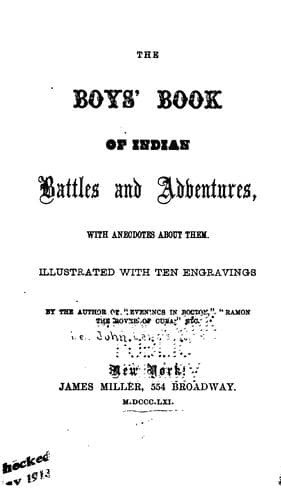
The boys' book of Indian battles and adventures, with anecdotes about them
History
The boys' book of Indian battles and adventures, with anecdotes about them
Indians of North America -- Anecdotes
Pontiac had distinguished himself at Detroit and Michillimackinac.
When the French gave up Canada (1760), their Indian allies still
preserved their hatred towards the English, and as Pontiac was the most
considerable enemy of that nation, the adjacent tribes _all came_ to him
as a support against them. Pontiac had advanced farther in civilization
than any of the neighbouring chiefs: he appointed a commissary during
the war of 1763, called Pontiac’s war; and issued bills of credit, on
each of which was pictured the thing desired, and the figure of an otter,
the symbol of his tribe. In 1763 Major Rogers sent a bottle of brandy to
him, which Pontiac was counselled not to drink, as it probably contained
poison. But with the greatest magnanimity he exclaimed, “It is not in his
power to _kill him_ who has so lately saved his life.”
THE IDOL OF THE PEORIAS. (FROM AN OLD TRAVELLER.)
“We arrived at the village of the Peorias, allies of the Illinois,
through a fine large meadow, which is many leagues long. This village is
situated on the banks of a little river, and surrounded with great pales
and posts: there are many trees on the banks, and the huts are built
beneath them. When we arrived there, I inquired for the hut of the grand
chief: I was well received by him and his first warriors. They had just
been beaten by the Foxes, their mortal enemies, and were now holding a
consultation about it. A young Indian lighted the calumet of peace; then
they brought me a dish of maize flour, called sagamité, sweetened with
the syrup of the maple-tree; and afterwards a dessert of dry fruits, as
good as Corinth raisins. The next day I saw a great crowd in the plain:
they were for making a dance in favour of their new Manitou; the high
priest had a bonnet of feathers, like a crown, on his head. I was at the
door of the temple of their false deity; he begged me to go in. Judge of
my astonishment, for this is the picture of their Manitou: his head hung
upon his breast, and looked like a goat’s; his ears and his cruel eye
were like those of a lynx, with the same kind of hair; his feet, hands,
and thighs were in form something like those of a man.
Public-domain text, read in full here on John Shaqi.
Reviews
Reviews
No reviews yet
Be the first to share your thoughts on this work.
Join the Discussion
Join the discussion
Sign in to leave a comment or review.
Sign InorCreate an account