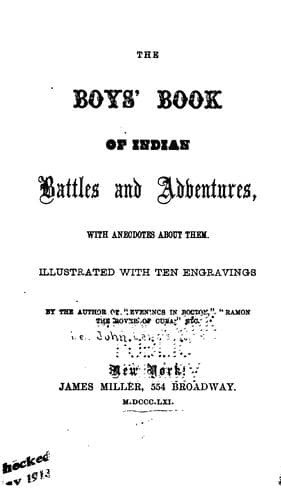
The boys' book of Indian battles and adventures, with anecdotes about them
History
The boys' book of Indian battles and adventures, with anecdotes about them
Indians of North America -- Anecdotes
Mr. Jones, an officer of the British army, had gained the affections
of Miss Macrea, a lovely young lady of amiable character and spotless
reputation, daughter of a gentleman attached to the royal cause, residing
near Fort Edward; and they had agreed to be married. In the course of
service, the officer was removed to some distance from his bride, and
became anxious for her safety and desirous of her company. He engaged
some Indians, of two different tribes, to bring her to camp, and promised
a keg of rum to the person who should deliver her safe to him. She
dressed to meet her bridegroom, and accompanied her Indian conductors;
but by the way, the two chiefs, each being desirous of receiving the
promised reward, disputed which of them should deliver her to her lover.
The dispute rose to a quarrel; and, according to their usual method of
disposing of a disputed prisoner, one of them instantly cleft the head
of the lady with his tomahawk. This simple story, sufficiently tragical
and affecting in itself, was blazoned in the American newspapers with
every amplification that could excite the imagination or touch the
heart; and contributed in no slight degree to embitter the minds of the
people against those who could degrade themselves by the aid of such
allies. The impulse given to the public mind by such atrocities more
than counterbalanced any advantages which the British derived from the
assistance of the Indians.
AN INDIAN IN COLLEGE.
The first serious disappointment which John Eliot, the Indian Apostle,
experienced, was in his efforts for the instruction of the Indian youth
in the classic languages; many of the ablest and most promising among
them were set apart for this purpose; his ambition was to bring them
up “with our English youth in university learning.” Where was the use
of this? Eliot’s best purposes were prone to be carried to excess. He
gave away a whole year’s salary, at a wretched cottage, while his wife
was probably expecting it at home for household demands. He had learned
his Indians to read and write; many could read English well; and now he
wished to give them a polite education, that must have sat as gracefully
on them as the full-sleeved gown and bands of the divine. Considerable
sums were expended in their board and education: a substantial building
of brick, which cost between three and four hundred pounds, was erected;
it was large enough to accommodate twenty scholars. It must have been
Spartan discipline to the heads as well as hearts of the poor Indians,
to labour morn and night through the Greek and Roman authors, to try to
discover and relish the beauties of style and the splendour of imagery.
No doubt, their thoughts sometimes fled away to their deserts, where
their fathers roved in dignity and freedom, and books never came. The
design might be praiseworthy, but Providence did not smile upon it, most
of these young men died when they had made great proficiency in their
Public-domain text, read in full here on John Shaqi.
Reviews
Reviews
No reviews yet
Be the first to share your thoughts on this work.
Join the Discussion
Join the discussion
Sign in to leave a comment or review.
Sign InorCreate an account