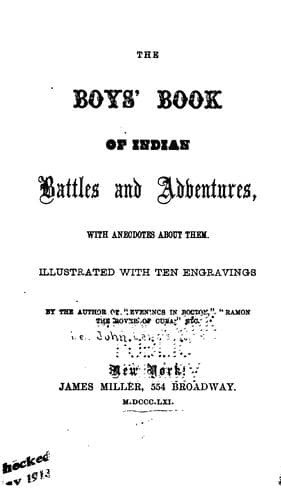
The boys' book of Indian battles and adventures, with anecdotes about them
History
The boys' book of Indian battles and adventures, with anecdotes about them
Indians of North America -- Anecdotes
studies, as if the languages wore out their hearts; others abandoned
their books, even when they were prepared to enter Harvard College, in
the town of Cambridge; their patience was probably exhausted, and the
boon of literary dignity could lure them no further. A few of these,
passing from one extreme to the other, burst their bonds at once; and
as if mind and body panted together to be free, hastened back to the
wilderness again, into its wigwams and swamps; where neither Homer nor
Ovid was like to follow them.
“These circumstances proved very discouraging to the godly in New
England,” says a contemporary. “Some were so far affected by them, as to
conceive that they were manifest tokens of the Divine disapprobation. Mr.
Eliot, however, whose faith was more vigorous, considered them merely as
trials, to which they ought to submit without reluctance.” In consequence
of the death and failure of those who entered the aforesaid building, it
was soon after chiefly occupied by the English. Only one of these Indian
students appears to have obtained his degree at Harvard College; and at
the conclusion of two Latin and Greek elegies, which he composed on the
death of an eminent minister, subscribed himself “Cheesecaumuk, Senior
Sophista.” What an incongruous blending of sounds!
Eliot at last saw his error, and, instead of the classics, applied with
fresh ardour to his more useful translations, of which the circulation
was so rapid, that he printed a fresh edition of the “Practice of
Piety.” He also soon after established a lecture at Naticke, in which he
explained the leading doctrines of theology and logic: here he was on
safe ground, and his labours were eminently useful. During the summer
months they assembled eagerly once a fortnight, and many of them gained
much knowledge; yet he was far from being satisfied with his oral
instructions, and he printed a thousand copies of a logic primer, and
made little systems of all the liberal arts, for the use of the Indians.
The same minds that had pined and sunk beneath the study of the classic
tongues, embraced these things with ardour.
[Illustration]
AN INDIAN WARRANT.
Judge Davis, in his Appendix to the Memorial, observes, that the
employment of the more intelligent and energetic Indians as rulers, was
particularly grateful to them. He had often heard of amusing anecdotes of
the Indian rulers. The following warrant is recollected, which was issued
by one of these magistrates, directed to an Indian constable, and will
not suffer in comparison with our more verbose forms.
‘I, Hihoudi, you Peter Waterman, Jeremy Wicket, quick you take him, fast
you hold him straight you bring him before me, Hihoudi.’
[Illustration]
[Illustration: Pocahontas Saving the Life of Captain Smith.
Page 99.]
CAPTAIN JOHN SMITH.
Public-domain text, read in full here on John Shaqi.
Reviews
Reviews
No reviews yet
Be the first to share your thoughts on this work.
Join the Discussion
Join the discussion
Sign in to leave a comment or review.
Sign InorCreate an account