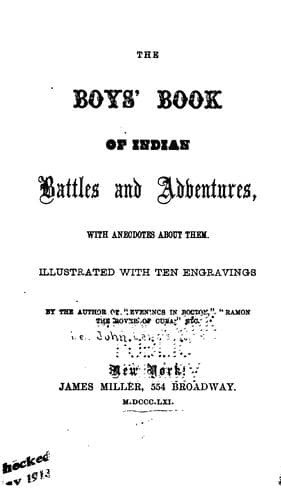
The boys' book of Indian battles and adventures, with anecdotes about them
History
The boys' book of Indian battles and adventures, with anecdotes about them
Indians of North America -- Anecdotes
“_He that delivereth it unto thee hath the greater sin._”
“I am glad,” said the Rev. Dr. Y⸺s to the chief of the Little Ottowas,
“that you do not drink whiskey. But it grieves me to find that your
people use so much of it.” “Ah, yes,” replied the Indian,—and he fixed an
arch and impressive eye upon the Doctor, which communicated the reproof
before he uttered it—“we Indians _use_ a great deal of whiskey, but we do
not _make_ it.”
LANGUAGE BY SIGNS.
It is pretty well ascertained that there exists among mankind a universal
language of signs, taught by nature herself. Voyagers have always used
these signs among savage and previously undiscovered nations. They are
always understood, and invariably form the basis of intercourse. The
former director of the Hartford Asylum for the Deaf and Dumb, informed
the writer, that all the mutes who came to that institution from
different parts of the country, brought with them signs and motions which
were essentially the same, and which coincided with those used in the
institution. This proves that they are _natural_.
Andrew Ellicott, Esq., commissioned by the United States to determine,
in conjunction with the Commissioners of Spain, a line of demarcation
between the territories of both nations,—related to the writer a curious
trait in the savage character.
On his way down the Mississippi, a number of strange Indians came
into his camp, from the west side of the river. A Mr. Nolin happened
to be there at the time,—well known for his enterprize and skill in
catching wild horses in the Internal Provinces of Spanish America. He
addressed them in such of the languages as he was acquainted with—but
was not understood. He then conversed by certain signs. These were
understood by the Indians, and were answered in like manner. Thus (if the
expression may be allowed) a conversation ensued, in which not a word was
spoken:—“and this,” said Nolin, “is a sort of universal language common
to the Western tribes.”—(_See Major Long’s Expedition._)
LOGAN.
Public-domain text, read in full here on John Shaqi.
Reviews
Reviews
No reviews yet
Be the first to share your thoughts on this work.
Join the Discussion
Join the discussion
Sign in to leave a comment or review.
Sign InorCreate an account