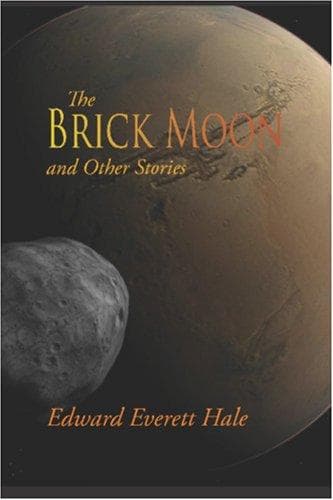
The Brick Moon, and Other StoriesHale, Edward Everett
Science
The Brick Moon, and Other Stories
Hale, Edward Everett
Short stories; United States -- Social life and customs -- 19th century -- Fiction
The Brick Moon
and Other Stories
by EDWARD EVERETT HALE
Short Story Index Reprint Series
Preface
To read these stories again, thirty and more years after
they were written, is to recall many memories, sad or
glad, with which this reader need not be interrupted.
But I have to make sure that they are intelligible to
readers of a generation later than that for which they
were written.
The story of The Brick Moon was begun in my dear
brother Nathan's working-room in Union College,
Schenectady, in the year 1870, when he was professor of
the English language there. The account of the first
plan of the moon is a sketch, as accurate as was needed,
of the old chat and dreams, plans and jokes, of our
college days, before he left Cambridge in 1838. As I
learned almost everything I know through his care and
love and help, directly or indirectly, it is a pleasure
to say this here. The story was published in the
"Atlantic Monthly," in 1870 and 1871. It was the last
story I wrote for that magazine, before assuming the
charge of "Old and New," a magazine which I edited from
1870 to 1876, and for which I wrote "Ten Times One is
Ten," which has been printed in the third volume of this
series.
Among the kind references to "The Brick Moon" which
I have received from sympathetic friends, I now recall
with the greatest pleasure one sent me by Mr. Asaph Hall,
the distinguished astronomer of the National Observatory.
In sending me the ephemeris of the two moons of Mars,
which he revealed to this world of ours, he wrote, "The
smaller of these moons is the veritable Brick Moon."
That, in the moment of triumph for the greatest
astronomical discovery of a generation, Dr. Hall should
have time or thought to give to my little parable,--this
was praise indeed.
Writing in 1870, I said, as the reader will see on
page 66, that George Orcutt did not tell how he used a
magnifying power of 700. Nor did I choose to tell then,
hoping that in some fortunate winter I might be able
myself to repeat his process, greatly to the convenience
of astronomers who have not Alvan Clark's resources at
hand, or who have to satisfy themselves with glass lenses
of fifteen inches, or even thirty, in diameter. But no
such winter has come round to me, and I will now give
Orcutt's invention to the world. He had unlimited
freezing power. So have we now, as we had not then.
With this power he made an ice lens, ten feet in
diameter, which was easily rubbed, by the delicate hands
of the careful women around him, to precisely the
surface which he needed. Let me hope that before next
winter passes some countryman or countrywoman of mine
will have equalled his success, and with an ice lens will
surpass all the successes of the glasses of our time.
Public-domain text, read in full here on John Shaqi.
Reviews
Reviews
No reviews yet
Be the first to share your thoughts on this work.
Join the Discussion
Join the discussion
Sign in to leave a comment or review.
Sign InorCreate an account