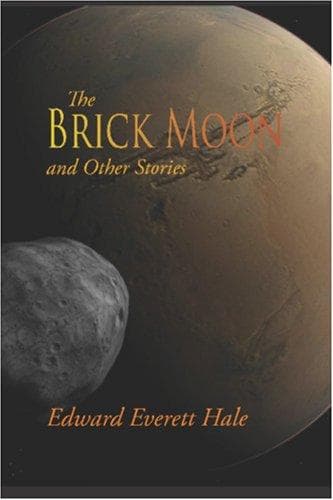
The Brick Moon, and Other StoriesHale, Edward Everett
Science
The Brick Moon, and Other Stories
Hale, Edward Everett
Short stories; United States -- Social life and customs -- 19th century -- Fiction
The plan of "Crusoe in New York" was made when I was
enjoying the princely hospitality of Henry Whitney
Bellows in New York. The parsonage in that city
commanded a view of a "lot" not built on, which would
have given for many years a happy home to any disciple of
Mayor Pingree, if a somewhat complicated social order had
permitted. The story was first published in Frank
Leslie's illustrated paper. In reading it in 1899, I am
afraid that the readers of a hard, money generation may
not know that "scrip" was in the sixties the name for
small change.
I regard a knowledge of every detail of the original
Robinson Crusoe as well-nigh a necessity in education.
Girls may occasionally be excused, but never boys. It
ought to be unnecessary, therefore, to say that some of
the narrative passages of Crusoe in New York are taken,
word for word, from the text of Defoe. If I do state
this for the benefit of a few unfortunate ladies who are
not familiar with that text, it is because I think no one
among many courteous critics has observed it.
"The Survivor's Story" is one of eight short stories
which were published in the first Christmas number of
"Old and New."
Of the other stories I think no explanation is
needed, but such as was given at the time of their
publication and is reprinted with each of them here.
EDWARD E. HALE.
ROXBURY, July 6, 1899.
CONTENTS
THE BRICK MOON
CRUSOE IN NEW YORK
BREAD ON THE WATERS
THE LOST PALACE
99 LINWOOD STREET
IDEALS
THANKSGIVING AT THE POLLS
THE SURVIVOR'S STORY
THE BRICK MOON
[From the papers of Captain FREDERIC INGHAM.]
I
PREPARATION
I have no sort of objection now to telling the whole
story. The subscribers, of course, have a right to
know what became of their money. The astronomers may
as well know all about it, before they announce any
more asteroids with an enormous movement in
declination. And experimenters on the longitude may as
well know, so that they may act advisedly in attempting
another brick moon or in refusing to do so.
It all began more than thirty years ago, when we were
in college; as most good things begin. We were studying
in the book which has gray sides and a green back, and is
called "Cambridge Astronomy" because it is translated
from the French. We came across this business of the
longitude, and, as we talked, in the gloom and glamour of
the old South Middle dining-hall, we had going the usual
number of students' stories about rewards offered by the
Board of Longitude for discoveries in that matter,--
stories, all of which, so far as I know, are lies. Like
all boys, we had tried our hands at perpetual motion.
For me, I was sure I could square the circle, if they
would give me chalk enough. But as to this business of
the longitude, it was reserved for Q.[1] to make the
happy hit and to explain it to the rest of us.
[1] Wherever Q. is referred to in these pages my
brother Nathan is meant. One of his noms de plume
was Gnat Q. Hale, because G and Q may be silent letters.
Public-domain text, read in full here on John Shaqi.
Reviews
Reviews
No reviews yet
Be the first to share your thoughts on this work.
Join the Discussion
Join the discussion
Sign in to leave a comment or review.
Sign InorCreate an account