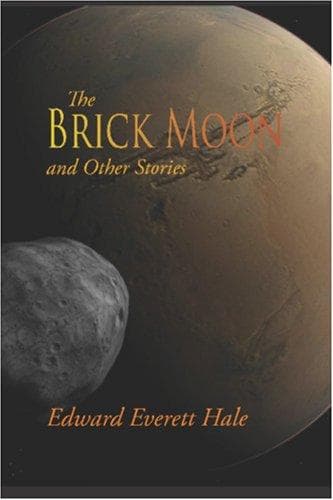
The Brick Moon, and Other StoriesHale, Edward Everett
Science
The Brick Moon, and Other Stories
Hale, Edward Everett
Short stories; United States -- Social life and customs -- 19th century -- Fiction
I wonder if I can explain it to an unlearned world,
which has not studied the book with gray sides and a
green cambric back. Let us try.
You know then, dear world, that when you look at the
North Star, it always appears to you at just the same
height above the horizon or what is between you and the
horizon: say the Dwight School-house, or the houses in
Concord Street; or to me, just now, North College. You
know also that, if you were to travel to the North Pole,
the North Star would be just over your head. And, if you
were to travel to the equator, it would be just on your
horizon, if you could see it at all through the red,
dusty, hazy mist in the north, as you could not. If you
were just half-way between pole and equator, on the line
between us and Canada, the North Star would be half-way
up, or 45@ from the horizon. So you would know there
that you were 45@ from the equator. Then in Boston, you
would find it was 42@ 20' from the horizon. So you know
there that you are 42@ 20' from the equator. At Seattle
again you would find it was 47@ 40' high, so our friends
at Seattle know that they are at 47@ 40' from the
equator. The latitude of a place, in other words, is
found very easily by any observation which shows how high
the North Star is; if you do not want to measure the
North Star, you may take any star when it is just to
north of you, and measure its height; wait twelve hours,
and if you can find it, measure its height again. Split
the difference, and that is the altitude of the pole, or
the latitude of you, the observer.
"Of course we know this," says the graduating world.
"Do you suppose that is what we borrow your book for, to
have you spell out your miserable elementary astronomy?"
At which rebuff I should shrink distressed, but that a
chorus of voices an octave higher comes up with, "Dear
Mr. Ingham, we are ever so much obliged to you; we did
not know it at all before, and you make it perfectly
clear."
Thank you, my dear, and you, and you. We will not
care what the others say. If you do understand it, or do
know it, it is more than Mr. Charles Reade knew, or he
would not have made his two lovers on the island guess at
their latitude, as they did. If they had either of them
been educated at a respectable academy for the Middle
Classes, they would have fared better.
Now about the longitude.
Public-domain text, read in full here on John Shaqi.
Reviews
Reviews
No reviews yet
Be the first to share your thoughts on this work.
Join the Discussion
Join the discussion
Sign in to leave a comment or review.
Sign InorCreate an account