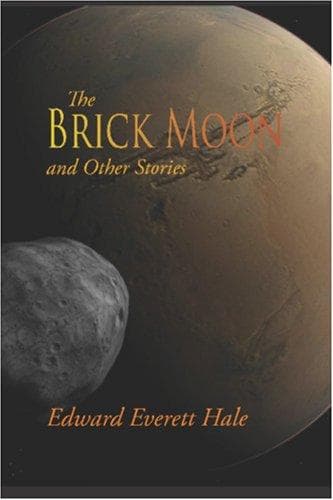
The Brick Moon, and Other StoriesHale, Edward Everett
Science
The Brick Moon, and Other Stories
Hale, Edward Everett
Short stories; United States -- Social life and customs -- 19th century -- Fiction
Night came. I was "sole alone"! B. M. came, more
than filled the field of vision, of course! but for that
I was ready. Heavens! how changed. Red no longer,
but green as a meadow in the spring. Still I could see--
black on the green--the large twenty-foot circles which
I remembered so well, which broke the concave of the
dome; and, on the upper edge--were these palm-trees?
They were. No, they were hemlocks, by their shape, and
among them were moving to and fro---------- flies? Of
course, I cannot see flies! But something is moving,--
coming, going. One, two, three, ten; there are more than
thirty in all! They are men and women and their
children!
Could it be possible? It was possible! Orcutt and
Brannan and the rest of them had survived that giddy
flight through the ether, and were going and coming on
the surface of their own little world, bound to it by its
own attraction and living by its own laws!
As I watched, I saw one of them leap from that
surface. He passed wholly out of my field of vision, but
in a minute, more or less, returned. Why not! Of course
the attraction of his world must be very small, while he
retained the same power of muscle he had when he was
here. They must be horribly crowded, I thought. No.
They had three acres of surface, and there were but
thirty-seven of them. Not so much crowded as people are
in Roxbury, not nearly so much as in Boston; and,
besides, these people are living underground, and have
the whole of their surface for their exercise.
I watched their every movement as they approached the
edge and as they left it. Often they passed beyond it,
so that I could see them no more. Often they sheltered
themselves from that tropical sun beneath the trees.
Think of living on a world where from the vertical heat
of the hottest noon of the equator to the twilight of the
poles is a walk of only fifty paces! What atmosphere
they had, to temper and diffuse those rays, I could not
then conjecture.
I knew that at half-past ten they would pass into the
inevitable eclipse which struck them every night at this
period of their orbit, and must, I thought, be a luxury
to them, as recalling old memories of night when they
were on this world. As they approached the line of
shadow, some fifteen minutes before it was due, I counted
on the edge thirty-seven specks arranged evidently in
order; and, at one moment, as by one signal, all thirty-
seven jumped into the air,--high jumps. Again they did
it, and again. Then a low jump; then a high one. I
caught the idea in a moment. They were telegraphing to
our world, in the hope of an observer. Long leaps and
short leaps,--the long and short of Morse's Telegraph
Alphabet,--were communicating ideas. My paper and pencil
had been of course before me. I jotted down the
despatch, whose language I knew perfectly:--
"Show `I understand' on the Saw-Mill Flat."
Public-domain text, read in full here on John Shaqi.
Reviews
Reviews
No reviews yet
Be the first to share your thoughts on this work.
Join the Discussion
Join the discussion
Sign in to leave a comment or review.
Sign InorCreate an account