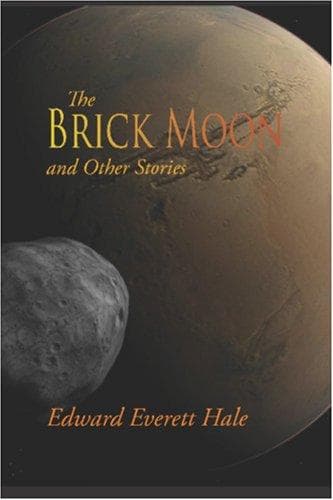
The Brick Moon, and Other StoriesHale, Edward Everett
Science
The Brick Moon, and Other Stories
Hale, Edward Everett
Short stories; United States -- Social life and customs -- 19th century -- Fiction
By "I understand" they meant the responsive signal
given, in all telegraphy, by an operator who has received
and understood a message.
As soon as this exercise had been three times
repeated, they proceeded in a solid body--much the most
apparent object I had had until now--to Circle No. 3, and
then evidently descended into the MOON.
The eclipse soon began, but I knew the MOON'S path
now, and followed the dusky, coppery spot without
difficulty. At 1.33 it emerged, and in a very few
moments I saw the solid column pass from Circle No. 3
again, deploy on the edge again, and repeat three times
the signal:--
"Show `I understand' on the Saw-Mill Flat."
It was clear that Orcutt had known that the edge of
his little world would be most easy of observation, and
that he had guessed that the moments of obscuration and
of emersion were the moments when observers would be most
careful. After this signal they broke up again, and I
could not follow them. With daylight I sent off a
despatch to Haliburton, and, grateful and happy in
comparison, sank into the first sleep not haunted by
horrid dreams, which I had known for years.
Haliburton knew that George Orcutt had taken with him
a good Dolland's refractor, which he had bought in
London, of a two-inch glass. He knew that this would
give Orcutt a very considerable power, if he could only
adjust it accurately enough to find No. 9 in the 3d
Range. Orcutt had chosen well in selecting the "Saw-Mill
Flat," a large meadow, easily distinguished by the
peculiar shape of the mill-pond which we had made. Eager
though Haliburton was to join me, he loyally took moneys,
caught the first train to Skowhegan, and, travelling
thence, in thirty-six hours more was again descending
Spoonwood Hill, for the first time since our futile
observations. The snow lay white upon the Flat. With
Rob. Shea's help, he rapidly unrolled a piece of black
cambric twenty yards long, and pinned it to the crust
upon the snow; another by its side, and another. Much
cambric had he left. They had carried down with them
enough for the funerals of two Presidents. Haliburton
showed the symbols for "I understand," but he could not
resist also displaying ..-- .--, which are the dots and
lines to represent O. K., which, he says, is the
shortest message of comfort. And not having exhausted
the space on the Flat, he and Robert, before night closed
in, made a gigantic O. K., fifteen yards from top to
bottom, and in marks that were fifteen feet through.
I had telegraphed my great news to Haliburton on
Monday night. Tuesday night he was at Skowhegan.
Thursday night he was at No. 9. Friday he and Rob.
stretched their cambric. Meanwhile, every day I slept.
Every night I was glued to the eye-piece. Fifteen
minutes before the eclipse every night this weird dance
of leaps two hundred feet high, followed by hops of
Public-domain text, read in full here on John Shaqi.
Reviews
Reviews
No reviews yet
Be the first to share your thoughts on this work.
Join the Discussion
Join the discussion
Sign in to leave a comment or review.
Sign InorCreate an account