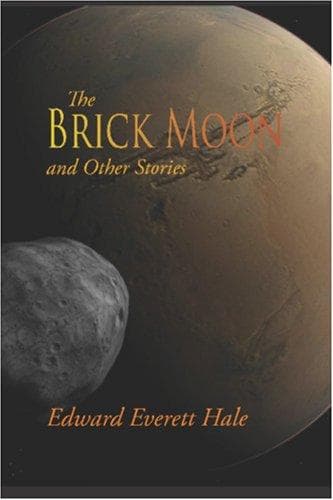
The Brick Moon, and Other StoriesHale, Edward Everett
Science
The Brick Moon, and Other Stories
Hale, Edward Everett
Short stories; United States -- Social life and customs -- 19th century -- Fiction
This difficulty about what we call "the strip,"
however, led to an improvement in the plan, which made it
better in every way. It was clear that even if "the
strip" were quite wide, the moon would have to be a good
way off, and, in proportion, hard to see. If, however,
we would satisfy ourselves with a moon four thousand
miles away, THAT could be seen on the earth's surface
for three or four thousand miles on each side; and twice
three thousand, or six thousand, is one fourth of the
largest circumference of the earth. We did not dare have
it nearer than four thousand miles, since even at that
distance it would be eclipsed three hours out of every
night; and we wanted it bright and distinct, and not of
that lurid, copper, eclipse color. But at four
thousand miles' distance the moon could be seen by a belt
of observers six or eight thousand miles in diameter.
"Start, then, two moons,"--this was my contribution to
the plan. "Suppose one over the meridian of Greenwich,
and the other over that of New Orleans. Take care that
there is a little difference in the radii of their
orbits, lest they `collide' some foul day. Then, in most
places, one or other, perhaps two will come in sight. So
much the less risk of clouds: and everywhere there may be
one, except when it is cloudy. Neither need be more than
four thousand miles off; so much the larger and more
beautiful will they be. If on the old Thornbush moon old
Herschel with his reflector could see a town-house two
hundred feet long, on the Brick Moon young Herschel will
be able to see a dab of mortar a foot and a half long, if
he wants to. And people without the reflector, with
their opera-glasses, will be able to see sufficiently
well." And to this they agreed: that eventually there
must be two Brick Moons. Indeed, it were better that
there should be four, as each must be below the horizon
half the time. That is only as many as Jupiter has. But
it was also agreed that we might begin with one.
Why we settled on two hundred feet of diameter I
hardly know. I think it was from the statement of dear
John Farrar's about the impossibility of there being a
state house two hundred feet long not yet discovered, on
the sunny side of old Thornbush. That, somehow, made
two hundred our fixed point. Besides, a moon of two
hundred feet diameter did not seem quite unmanageable.
Yet it was evident that a smaller moon would be of no
use, unless we meant to have them near the world, when
there would be so many that they would be confusing, and
eclipsed most of the time. And four thousand miles is a
good way off to see a moon even two hundred feet in
diameter.
Public-domain text, read in full here on John Shaqi.
Reviews
Reviews
No reviews yet
Be the first to share your thoughts on this work.
Join the Discussion
Join the discussion
Sign in to leave a comment or review.
Sign InorCreate an account