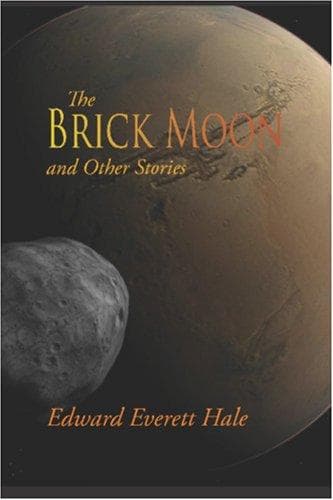
The Brick Moon, and Other StoriesHale, Edward Everett
Science
The Brick Moon, and Other Stories
Hale, Edward Everett
Short stories; United States -- Social life and customs -- 19th century -- Fiction
Failing that, after various propositions, he
suggested the Brick Moon. The plan was this: If from
the surface of the earth, by a gigantic peashooter, you
could shoot a pea upward from Greenwich, aimed northward
as well as upward; if you drove it so fast and far that
when its power of ascent was exhausted, and it began to
fall, it should clear the earth, and pass outside the
North Pole; if you had given it sufficient power to get
it half round the earth without touching, that pea would
clear the earth forever. It would continue to rotate
above the North Pole, above the Feejee Island place,
above the South Pole and Greenwich, forever, with the
impulse with which it had first cleared our atmosphere
and attraction. If only we could see that pea as it
revolved in that convenient orbit, then we could measure
the longitude from that, as soon as we knew how high the
orbit was, as well as if it were the ring of Saturn.
"But a pea is so small!"
"Yes," said Q., "but we must make a large pea." Then
we fell to work on plans for making the pea very large
and very light. Large,--that it might be seen far away
by storm-tossed navigators: light,--that it might be the
easier blown four thousand and odd miles into the air;
lest it should fall on the heads of the Greenlanders or
the Patagonians; lest they should be injured and the
world lose its new moon. But, of course, all this lath-
and-plaster had to be given up. For the motion through
the air would set fire to this moon just as it does to
other aerolites, and all your lath-and-plaster would
gather into a few white drops, which no Rosse telescope
even could discern. "No," said Q. bravely, "at the least
it must be very substantial. It must stand fire well,
very well. Iron will not answer. It must be brick; we
must have a Brick Moon."
Then we had to calculate its size. You can see, on
the old moon, an edifice two hundred feet long with any
of the fine refractors of our day. But no such
refractors as those can be carried by the poor little
fishermen whom we wanted to befriend, the bones of whose
ships lie white on so many cliffs, their names
unreported at any Lloyd's or by any Ross,
Themselves the owners and their sons the crew.
On the other hand, we did not want our moon two hundred
and fifty thousand miles away, as the old moon is, which
I will call the Thornbush moon, for distinction. We did
not care how near it was, indeed, if it were only far
enough away to be seen, in practice, from almost the
whole world. There must be a little strip where they
could not see it from the surface, unless we threw it
infinitely high. "But they need not look from the
surface," said Q.; "they might climb to the mast-head.
And if they did not see it at all, they would know that
they were ninety degrees from the meridian."
Public-domain text, read in full here on John Shaqi.
Reviews
Reviews
No reviews yet
Be the first to share your thoughts on this work.
Join the Discussion
Join the discussion
Sign in to leave a comment or review.
Sign InorCreate an account