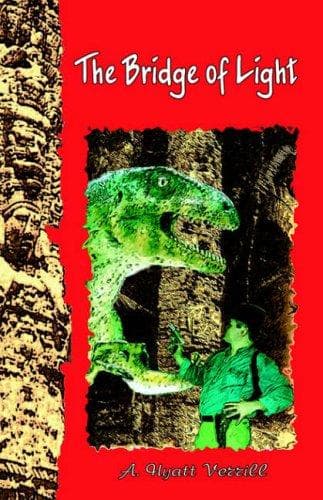
The bridge of lightVerrill, A. Hyatt (Alpheus Hyatt)
Science
The bridge of light
Verrill, A. Hyatt (Alpheus Hyatt)
Adventure stories; Central America -- Fiction; Mayas -- Fiction; Science fiction
THE “that” which Fray José gave me to serve as an open sesame to the
Mayan priest was a strange combination of the old and the new, of the
pagan and the Christian. Upon a sheet of paper bearing the figure
of the Cross, he had written a message in hieroglyphic symbols, and
accompanying this, was a tiny bag of painted hide containing a medal
of St. Christopher and a tiny golden image of a Mayan deity. Good Fray
José was no narrow-minded bigot but was willing to recognize conditions
as they were and to make necessary concessions to the occasions that
arose. If the Indians were willing to please him by assuming the veneer
of Christianity, he was quite willing to reciprocate by pleasing the
Indians to the extent of employing pagan symbols and following pagan
customs, though he had no more faith in them than the Indians had in
his Church and its rites.
It is needless to describe the details of my trip to Totil or to
narrate my experiences while I remained in the isolated little Indian
village, studying the ancient Zutugil language under the tutelage of
the painstaking patient Pedro, a dignified-looking Indian, who, being
in charge of Fray José’s most outlying chapel, regarded himself as a
dignitary of the Church of Rome and the most important and exalted
personage in the district. But, being Indian, he was Indian to the
core, and I was both interested and amused to discover that he had
painted the images of all the saints a mahogany brown, and had painted
the figure of Christ upon the crucifix inky-black.
“It is that the people may regard them with greater reverence,” he
explained when I asked him about it. “How can one expect an Indian to
adore the white Santos when they have received nothing but harm from
those of white skin?” he asked. “And,” he added, “how can the white
Santos or the white Cristo know what is good for the brown Indians?”
Then, a bit hesitantly and shamefacedly, “and besides, the great God
of our ancestors was black and with a black Cristo before them they
feel that they are worshipping Ekah and are more devout. Does the Señor
think I have done wrong?”
I assured him I did not. If, by painting the images, he won more
converts or added to the sincerity of their devotions, I considered
the means were justified by the end. But I felt quite sure that Pedro
himself preferred a black Saviour and brown saints to those with white
skins, for which I could not blame him much either.
But regardless of his religious idiosyncracies, Pedro was an excellent
teacher of his native tongue, and at the end of six weeks in his
village, he assured me that I had mastered enough of the Zutugil
language to continue on my journey; although, he added: “No white man
can learn the tongue of my people. Even Fray José speaks it always with
the tongue of the white man.”
Accompanied by four Indians who acted as guides, porters and camp-boys,
I started on what I believed at the time to be the last lap of my
journey.
Public-domain text, read in full here on John Shaqi.
Reviews
Reviews
No reviews yet
Be the first to share your thoughts on this work.
Join the Discussion
Join the discussion
Sign in to leave a comment or review.
Sign InorCreate an account