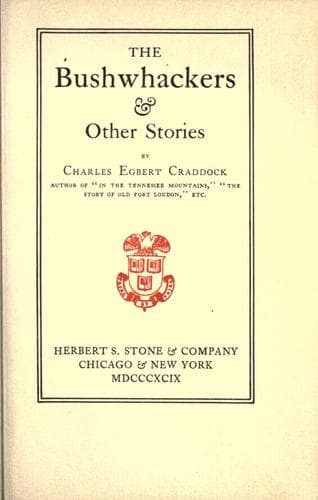
The bushwhackers & other storiesCraddock, Charles Egbert
General
The bushwhackers & other stories
Craddock, Charles Egbert
Mountain life -- Fiction; Tennessee -- Social life and customs -- Fiction
For this was what they called him--“_Poor Baby Bunting!_” They were
a small reconnoitering party of his own comrades, and it was with a
hearty good will that they pursued Jack Bixby who fled, as from his
enemies, through the brush. Perhaps his enemies would have been gentler
with him than his quondam friends could they only have laid hands on
him, for they all loved “Baby Bunting” for his brave spirit and his
little simplicities and his hearty good-comradeship. Hilary recognized
none of them. He only had a vague idea of Captain Bertley’s face with
a grave anxiety and a deep pity upon it as the officer gazed down at
him when he was borne past on the stretcher to the field hospital
where his right arm was taken off by the surgeon. He was treated as
kindly as possible, for the remembrance of his gallant spirit as well
as humanity’s sake, and when at last he was discharged from the more
permanent hospital to which he had been removed he realized that he
had indeed done with war and fine deeds of valiance, and he set out to
return home, tramping the weary way to the mountain and his mother.
After that fateful day, when maimed and wan and woebegone he came forth
from the hospital and journeyed out from among the camps and flags
and big guns and all the armaments of war, thrice splendid to his
backward gaze, it seemed to him that he had left there more than was
visible--that noble identity of valor for which he had revered himself.
For he found as he went a strange quaking in his heart. It was an
alien thing, and he strove to repudiate it, and ached with helpless
despair. When he came into unfamiliar regions, and a sudden clatter
upon the lonely country road would herald the approach of mounted
strangers, halting him, the convulsive start of his maimed right
arm with the instinct to seize his weapons and the sense of being
defenseless utterly would so unnerve him that he would give a
disjointed account of himself, with hang-dog look and faltering words.
And more than once he was seized and roughly handled and dragged
to headquarters to show his papers and be at last passed on by the
authorities.
He began to say to himself that his courage was in his cavalry pistol.
“Before God!” he cried, “me an’ my right arm an’ my weepon air like
saltpetre an’ charcoal an’ sulphur--no ’count apart. An’ tergether
they mean _gunpowder_!”
And doubly bereaved, he had come in sight of home.
But his mother fell upon his neck with joy, and the neighbors gathered
to meet him. The splendors of the Indian summer were deepening upon the
mountains, with gorgeous fantasies of color, with errant winds harping
æolian numbers in the pines, with a translucent purple haze and a great
red sun, and the hunter’s moon, most luminous. The solemnity and peace
stole in upon his heart, and revived within him that cherished sense of
home, so potent with the mountaineer, and in some wise he was consoled.
Public-domain text, read in full here on John Shaqi.
Reviews
Reviews
No reviews yet
Be the first to share your thoughts on this work.
Join the Discussion
Join the discussion
Sign in to leave a comment or review.
Sign InorCreate an account