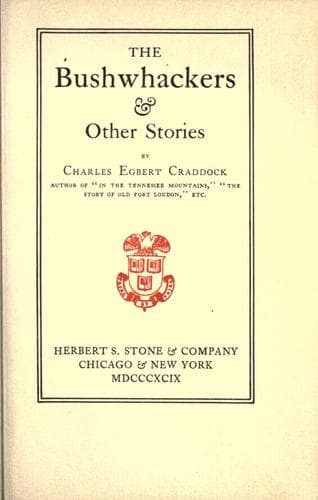
The bushwhackers & other storiesCraddock, Charles Egbert
General
The bushwhackers & other stories
Craddock, Charles Egbert
Mountain life -- Fiction; Tennessee -- Social life and customs -- Fiction
Yet he hardly paused. In this lighter mood he went on to the
settlement, eager that the news of his coming should not precede him.
There was the bridge to cross and the rocky ascent, and at the summit
stood the first log cabin of the scattered little hamlet. From the
porch, overgrown with hop vines, he heard the whir of a spinning wheel.
He saw the girl who stood beside it before she noticed the sound of
his step. Then she turned, staring at him with startled recognition,
despite all the changes wrought in the past two years. “It air me,” he
said, jocosely.
From his hollow eyes and sunken cheeks and wan smile her gaze fell
upon his empty sleeve. She suddenly threw her arm across her face.
“I--I--can’t abide ter look at ye!” she faltered, with a gush of tears.
He stood dumfounded for a moment.
“Durn it!” he cried. “I can’t abide ter look at myself!”
And with a bitter laugh he turned on his heel.
He would not be reconciled later. The wound she had unintentionally
dealt him rankled long. He said Delia Noakes was a sensible girl.
Plenty of brave fellows would come home from the war, hale and hearty
and with two good arms, better men in every way, in mind and body
and heart and soul, for the stern experiences they were enduring so
stanchly. The crop of sweethearts promised to be indeed particularly
fine, and there was no use in wasting politeness on a fellow with
whom she used to play before either of them could walk, but whose
arm was gone now, through no glorious deed wrought for his country,
for which he had intended to do all such service as a man’s right
arm might compass, but because he was a fool, and had made a friend
of a malevolent scoundrel, who had nearly taken his life, but had
only--worse luck--taken his right arm! And besides he had seen enough
of the world in his wanderings to know that it behooves people to
look to the future and means of support. He had learned what it was to
be hungry, he had learned what it was to lack. He was no longer the
brave and warlike man-at-arms, “Baby Bunting.” He had no vocation,
no possibility of a future of usefulness; he could not hold a gun or
a plow or an ax, and Delia doubtless thought he would not be able to
provide for her. And “dead shot” though he had been he could not now
defend himself, he declared bitterly, much less her.
CHAPTER III
It was the last month of the year, and the month was waning. The winds
had rifled the woods and the sere leaves all had fallen. Yet still a
bright after-thought of the autumnal sunshine glowed along the mountain
spurs, for the tardy winter loitered on the way, and the silver rime
that lay on the black frost-grapes melted at a beam.
“The weather hev been powerful onseasonable an’ onreasonable, ter
my mind,” said old Jonas Scruggs, accepting a rickety chair in his
neighbor’s porch. “’Tain’t healthy.”
Public-domain text, read in full here on John Shaqi.
Reviews
Reviews
No reviews yet
Be the first to share your thoughts on this work.
Join the Discussion
Join the discussion
Sign in to leave a comment or review.
Sign InorCreate an account