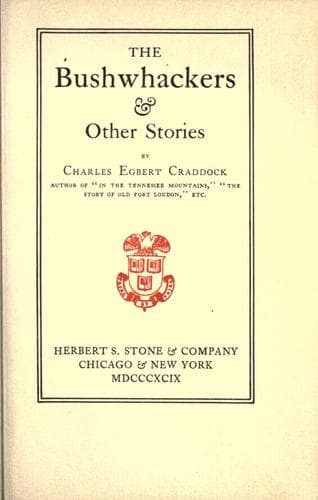
The bushwhackers & other storiesCraddock, Charles Egbert
General
The bushwhackers & other stories
Craddock, Charles Egbert
Mountain life -- Fiction; Tennessee -- Social life and customs -- Fiction
In the depths of the chasm spanned by the bridge there stood in
the shadow of one of the great cliffs a forlorn little log hut, so
precariously perched on the ledgy slope that it might have seemed the
nest of some strange bird rather than a human habitation. The huge
natural column of the crag rose sheer and straight two hundred feet
above it, but the descent from the door, though sharp and steep, was
along a narrow path leading in zigzag windings amid great bowlders and
knolls of scraggy earth, pushing their way out from among the stones
that sought to bury them, and fragments of the cliff fallen long ago
and covered with soft moss. The path appeared barely passable for man,
but upon it could have been seen the imprint of a hoof, and beside
the hut was a little shanty, from the rude window of which protruded
a horse’s head, with so interested an expression of countenance
that he looked as if he were assisting at the conversation going on
out-of-doors this mild March afternoon.
“Ye could find deer, an’ bar, an’ sech, easy enough ef ye would go
arter ’em,” replied the young hunter’s mother, as she sat in the
doorway knitting a yarn sock. “That thar still-house up yander ter the
Ridge hev skeered off the deer an’ bar fur ye worse’n the railroad
hev. Ye kin git that fur an’ no furder. Ye hev done got triflin’ an’ no
’count, an’ nuthin’ else in this worl’ ails ye,--nur the deer an’ bar,
nuther,” she concluded, with true maternal candor.
“It war tole ter me,” said an elderly man, who was seated in a
rush-bottomed chair outside the door, and who, although a visitor, bore
a lance in this domestic controversy with much freedom and spirit, “ez
how ye hed done got religion up hyar ter the Baptis’ meetin’-house the
last revival ez we hed. An’ I s’posed it war the truth.”
“I war convicted,” replied the young fellow, ambiguously, still leaning
lazily on his rifle. He was a striking figure, remarkable for a massive
proportion and muscular development, and yet not lacking the lithe,
elastic curves characteristic of first youth. A dilapidated old hat
crowned a shock of yellow hair, a sunburned face, far-seeing gray eyes,
and an expression of impenetrable calm. His butternut suit was in
consonance with the prominent ribs of his horse, the poverty-stricken
aspect of the place, and the sterile soil of a forlorn turnip patch
which embellished the slope to the water’s edge.
“Convicted!” exclaimed his mother, scornfully. “An’ sech goin’s-on
sence! Mark never _hed_ no religion to start with.”
“What did ye see when ye war convicted?” demanded the inquisitive
guest, who spoke upon the subject of religion with the authority and
asperity of an expert.
“I never seen nuthin’ much.” Mark Yates admitted the fact reluctantly.
“Then ye never _hed_ no religion,” retorted Joel Ruggles. “I _knows_,
’kase I hev hed a power o’ visions. I hev viewed heaven an’ hung over
hell.” He solemnly paused to accent the effect of this stupendous
revelation.
Public-domain text, read in full here on John Shaqi.
Reviews
Reviews
No reviews yet
Be the first to share your thoughts on this work.
Join the Discussion
Join the discussion
Sign in to leave a comment or review.
Sign InorCreate an account