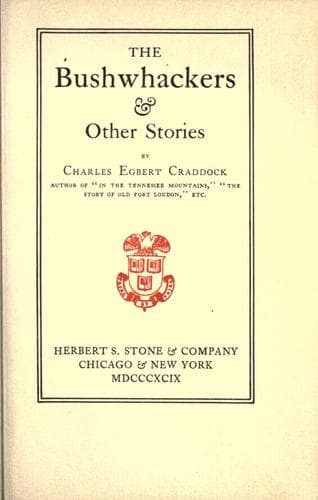
The bushwhackers & other storiesCraddock, Charles Egbert
General
The bushwhackers & other stories
Craddock, Charles Egbert
Mountain life -- Fiction; Tennessee -- Social life and customs -- Fiction
The whole affair seemed to the mess serious enough. For the Chickasaws,
baffled and furious, had threatened his life on their return,
reinforced by a dozen excited, elated, expectant tribesmen, laden with
light wood and a chain, to find their prisoner gone. But after the
first wild outburst of rage and despair Choolah, although evidently
strongly tempted to force the Highlander to the fate from which he had
rescued the French officer, resolved to preserve the integrity of his
nation’s pledge of amity with the British, and restrained his men from
offering injury. This was rendered the more acceptable to him, as with
his alert craft he perceived a keen retribution for Ronald MacDonnell
in the displeasure of his commanding officer, for the Chickasaws well
understood the discipline of the army, which they chose to disregard.
To better enlist the prejudice of Colonel Grant, Choolah was preparing
himself to distort the facts. He upbraided Ronald MacDonnell with
causelessly liberating a prisoner, a Frenchman and an officer, taken
by the wily exploit of another. As to the dry wood, he said, the
Chickasaws had merely brought some drift, long stranded in a cave by
the waterside, to replenish the fire, kindled with how great difficulty
in the soaking condition of the forests the Lieutenant well knew.
“Hout!--just now when we are about to cross the river?” cried Ronald,
unmasking the subterfuge. “And for what then that stout chain?”
The chain, Choolah protested, was but part of the equipment of one of
the pack animals that had broken away and had been plundered by the
Cherokees. Did the Lieutenant Plaidman think he wanted to chain the
prisoner to the stake to burn? He had had no dream of such a thing!
It was not the custom of the Chickasaws to waste so much time on a
prisoner. It was sufficient to cut him up in quarters; that usually
killed him dead,--quite dead enough! But if the Lieutenant had had a
chain, since he knew so well the use of one, doubtless he himself would
have joyed to burn the prisoner, provided it had been his own exploit
that had taken him,--for did not the Carolinians of the provincial
regiment say that when the Tartan men were at home they were as wild
and as uncivilized as the wildest Cherokee savage!
“_Holauba! Holauba! Feenah!_” (It is a lie. It is a lie, undoubtedly),
cried the phlegmatic MacDonnell, excited to a frenzy. He spoke in the
Chickasaw language, that the insult might be understood as offered with
full intention.
Public-domain text, read in full here on John Shaqi.
Reviews
Reviews
No reviews yet
Be the first to share your thoughts on this work.
Elsewhere in the archive
Join the Discussion
Join the discussion
Sign in to leave a comment or review.
Sign InorCreate an account