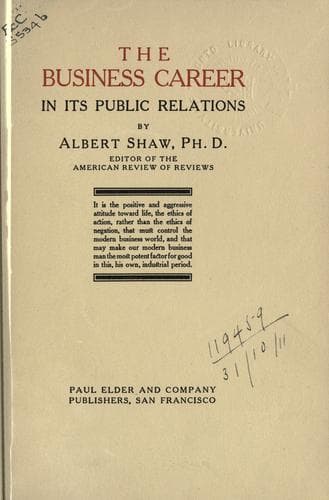
The business career in its public relationsShaw, Albert
Philosophy
The business career in its public relations
Shaw, Albert
Business ethics
Furthermore, with the development of business on the great scale,
capital had become relatively abundant and cheap, while, on the other
hand, labor was becoming relatively expensive and exacting. It was
evident that the modern system of industry had passed through its
earlier period to one of comparative maturity; and that the problem of
wealth production was no longer so exclusively the pressing one, but
that the problems of distribution were demanding more attention.
How to organize business life on a basis at once stable and efficient;
how to see that capital was assured of a normal even though a declining
percentage of dividends; while labor should be rewarded according to
its capacity and desert,--were problems which took on public rather
than private aspects. And when the business world began to face these
problems with the consciousness that they were to be met, it had
virtually passed over from the lower plane of moral and social
responsibility to the higher plane where what the directing minds do or
decide is not measured solely by immediate results in money-getting,
but also by the test of larger social and public utilities.
Although these conditions are not novel ones, and are therefore not
difficult to grasp even when stated in general terms, it is still true
that the concrete often helps to make the point appear more pertinent.
Take then the railroad business as it is now shaping itself, in
comparison with its conditions and methods twenty or thirty years ago.
The railroads have always existed by virtue of charters which gave them
a quasi-public character, and have always been theoretically subject to
certain old principles of English common law under which the public or
common carrier, like the innkeeper, performs a function not wholly
private in its nature. Nevertheless, in its earlier stages the railroad
system of this country was in large part constructed and operated by
its projectors with no sense whatever of responsibility for their
performance of public functions, but with the idea that they were
carrying on their own private business in which interference on the
part of the public was to be avoided and resented. They fought the
railroad codes of State legislatures in the federal courts; they made
oppressive rates to give value to new issues of watered stock; they
discriminated in favor of one city and against another; by a system of
secret rebates they made different terms with every shipper, thus
enabling one merchant or manufacturer to destroy his competitor; and
they pursued in general a career at least anti-social in its spirit and
false and short-sighted in its principles.
Public-domain text, read in full here on John Shaqi.
Reviews
Reviews
No reviews yet
Be the first to share your thoughts on this work.
Join the Discussion
Join the discussion
Sign in to leave a comment or review.
Sign InorCreate an account