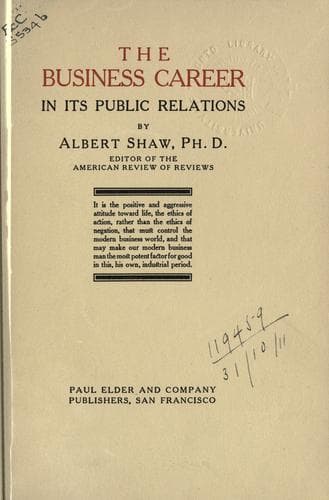
The business career in its public relations — John Shaqi
The business career in its public relationsShaw, Albert
Philosophy
The business career in its public relations
Shaw, Albert
Business ethics
All modern business life, then, is the result of this growth of
productive capital, and its application and constant reapplication to
the production of wealth. It made its way by virtue of an intense
individual initiative and a fierce competitive struggle. But unlovely
as were these things, many of their phases were necessary at a certain
stage. It was this fierce competition that compelled capital to pay the
lowest possible wages in order to market cheap goods. But the same
situation stimulated the use, one after another, of new labor-saving
inventions in order to increase the per capita productivity. This
process was attended by the higher efficiency of the worker and an
increase in his earning capacity. As his position began to improve, the
worker gained some hope and cheer; and he and his fellows began to
organize, with the result that both wages and conditions of labor were
steadily improved, and the workman began to attain approximately his
share of benefits.
All this is a familiar story, although the depth of its significance is
beyond the compass of any living human intelligence. It is easy to say
in a glib sentence that the amount of wealth produced every few years
nowadays is equal to all the accumulated wealth of all the centuries
down to the early part of the nineteenth; but the social meaning of so
great a change baffles all attempt at full comprehension.
The competitive system, which had been essential to the launching of
this modern period of production, and which had given to it so much of
its irresistible momentum, at length brought the economic organization
to a point of development where, in some fields of production, it was
no longer a benefit. The accumulation of capital had become so
large,--and with new inventions the possible output had become so
abundant, that it was well nigh impossible to trust to the blind
working of demand and supply to regulate things in a beneficial way. It
began to dawn on men's minds that a successful period of competitive
economic life might lead to a period largely dominated by
non-competitive and cooperative principles.
The superior possibilities of this newest regime, along with its many
difficulties and perplexities, began to captivate the minds, not merely
of theoretical students and onlookers, but, even more, of great masters
of industry and productive capital. It began to be seen that in place
of blind and fierce competition as a regulator of prices and as an
equalizer of supply and demand, there might come to be gradually
substituted some more consciously scientific methods of business
administration and of the adjustment of production to the needs of the
market.
Public-domain text, read in full here on John Shaqi.
Reviews
Reviews
No reviews yet
Be the first to share your thoughts on this work.
Join the Discussion
Join the discussion
Sign in to leave a comment or review.
Sign InorCreate an account