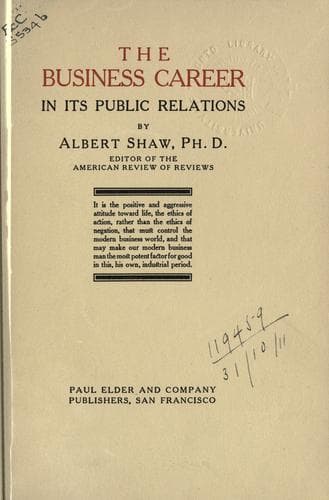
The business career in its public relationsShaw, Albert
Philosophy
The business career in its public relations
Shaw, Albert
Business ethics
Mr. Mellen's state of mind is that which ought to prevail among all the
managers of corporations which enjoy public franchises and perform
functions fundamental to the welfare of the community. There will at
times be prejudice and passion on the part of the public, and unfair
demands will be made. We shall not see the attainment of ideal
conditions in the management or the public relations of any great
business corporations in our day. But the time has come when any
intelligent and capable young man who chooses to enter the service of a
railroad or of some other great corporation may rightly feel that he
becomes part of a system whose operation is vital to the public
welfare. He may further feel that there is room in such a calling for
all his intelligence and for the exercise and growth of all the best
sentiments of his moral nature.
In the vast mechanism of modern business the constructive imagination
may find its full play; and the desire to be of service to one's fellow
men in a spirit reasonably disinterested may find opportunity to
satisfy itself every day. Under these circumstances there is no reason
why railway administration should not take on the same ethical
standards as belong rightly to governmental administration, to
educational administration, or to the best professional life.
The same thing is clearly true when one considers nowadays the delicate
and important functions of the world of banking and finance. The
old-fashioned money-changer and the usurer of earlier periods were
regarded as the very antithesis of men engaged in honorable mercantile
life, and especially of those who possess a social spirit and the
desire to be useful members of the community. But in these days the
banks are not merely private money-making institutions, but have public
functions that admittedly affect the whole social organism, from the
government itself down to the humblest laborer. They must concern
themselves about the soundness and the sufficiency of the monetary
circulation; they must protect the credit and foster the welfare of
honest merchants and manufacturers; they must cooperate in critical
times to help one another, and thus to sustain the public and private
credit and avert commercial disaster; they must at all hazards protect
the savings of the poor. Thus the banks, like the railroads and many
other corporate enterprises, are quasi-public affairs, in the conduct
of which the public obligation grows ever clearer and stronger.
Public-domain text, read in full here on John Shaqi.
Reviews
Reviews
No reviews yet
Be the first to share your thoughts on this work.
Join the Discussion
Join the discussion
Sign in to leave a comment or review.
Sign InorCreate an account