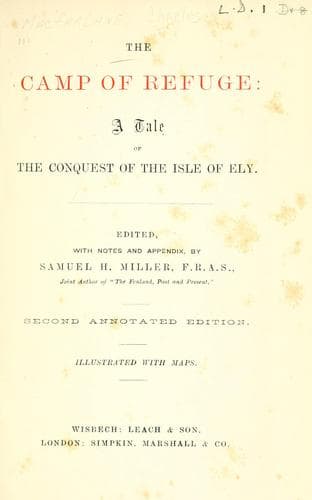
The Camp of Refuge: A Tale of the Conquest of the Isle of ElyMacFarlane, Charles
History
The Camp of Refuge: A Tale of the Conquest of the Isle of Ely
MacFarlane, Charles
Great Britain -- History -- Medieval period, 1066-1485 -- Fiction
[It was a good law of King Canute, which said that every free man in
England might hunt in his own woods and grounds, and hunt as much as he
list, provided only he interfered not with the royal parks and
demesnes. But the Norman princes, not content with spreading their
parks all over the country, and with seizing upon the lands of the
church and the poor to make them great hunting-grounds and deer-parks,
established cruel laws therewith, so that whosoever slew a hart or a
hind should be deprived of his eyesight; and Duke William forbade men
to kill the hart or the boar, and, as our Saxon chronicler saith, he
loved the tall deer as if he were their father! and likewise he decreed
that none should kill so much as a hare, and at this the rich men
bemoaned and the poor men shuddered. Old England will not be England
until these un-Saxon laws be entirely gone from us!][151]
From this good sport Lord Hereward returned to the house about an hour
before the sun reached the meridian, and then was served the abundant
dinner in the hall; and the not stinted dinner in the kitchen for the
churls and serfs followed the dinner in the hall. If the weather was
fine, the lady as well as the lord went out in the afternoon to hawk,
or to fish, or to see the pleasant and profitable sport of their expert
fenners who snared the wild fowl, or took the animals of the chace by
means of _fovea_ or deep pitfalls which they cunningly dug in the
ground in the likeliest places, and still more cunningly concealed by
laying across them sticks, and twigs, and moss, and turf. As the sun
set they returned again to the house and sang in concert with all the
household the _Ave Maria_ or they went into the little church and heard
the full service of Vespers. Upon these duties of religion there
followed a slight _merenda_ or afternoon’s drinking, or refection
between dinner and supper; and then Elfric or some other skilful wight
made music in the hall by playing upon the harp and singing; or
Alefricus, that learned clerk, brought down a book and read in it, or
the freedmen and elders of the township gathered round the cheerful
hearth with the lord and ladie, and related tales and legends of the
old times, or took counsel with Hereward as to the future. If a Saxon
gleeman came that way he was ever welcome; and these evening hours were
often made to pass away the more pleasantly by the arrival of such a
stranger, who, mayhap, could sing a new song, or tell an unheard tale,
or give some little intelligence of what was passing in the upland
country and in the world beyond the fens. No Saxon chief of fame ever
stinted the bard; and whether he went south or north, east or west, the
menestrel found every hall open to him, and had but to speak his wants
and to raise his grateful voice, and all and more than he wanted was
given unto him. When he entered a house they brought him water to wash
his hands and warm water for his feet, or they prepared for him the
Public-domain text, read in full here on John Shaqi.
Reviews
Reviews
No reviews yet
Be the first to share your thoughts on this work.
Elsewhere in the archive
Join the Discussion
Join the discussion
Sign in to leave a comment or review.
Sign InorCreate an account