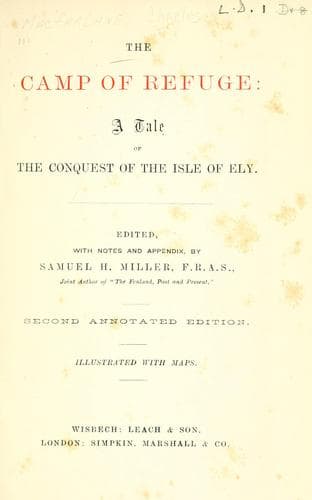
The Camp of Refuge: A Tale of the Conquest of the Isle of ElyMacFarlane, Charles
History
The Camp of Refuge: A Tale of the Conquest of the Isle of Ely
MacFarlane, Charles
Great Britain -- History -- Medieval period, 1066-1485 -- Fiction
warm bath, which was ever offered in good Saxon houses on the arrival
of an honoured and welcome guest—and where was the guest that could be
more welcome than the bard? So dearly did the Lord of Brunn love the
sound of the harp that it was his occasional custom now, and his
constant custom in after-life, to place a harper near his bedchamber to
amuse and solace him upon occasion, and for the exhilaration of his
spirits and as an excitement to devotion. And it was because Hereward
so loved menestrels, and pious and learned men of the Saxon stock, that
his friends and adherents were so numerous while he was living, and his
deeds so faithfully recorded and lovingly preserved when he was dead.
Thus music and talk brought on the hour for supper; and after supper
the good mass-priest said prayers in the hall to gentle and simple; and
then, when a good watch had been set, all of the household went to
their beds and prayed to lead as happy a life on the morrow as that
which they had led to day: for, whether serfs, or free-born men, or
manumitted churls, all were happy at Ey, and most kindly entreated by
lord and ladie twain; in such sort that what happened in other houses,
as the running away of serfs, or the putting collars round their necks
and gyves to their legs to prevent their running away, never happened
here or at Brunn.
And if they lived thus happily and orderly for these few days at Ey,
when danger was close at hand, and when they might be said to be living
in the midst of perils and uncertainties, I wist their rule was not
changed at a later time of their lives, when Hereward and Alftrude came
to dwell in safety and tranquility at the noble old house at Brunn.
But during these few tranquil days at Ey the young bride’s mind was at
times clouded by the thought that her husband must soon leave her to
contend with the pitiless Normans, and to rush into all the hazards of
war; and, Saxon-hearted as she was, this afflictive thought, being
aided by the gentleness of her nature, which ever revolted at
bloodshed, made her long for a peace upon almost any terms, not even
excepting that of submission to the Norman dominion. “My Hereward!”
said the Ladie Alftrude, “it is now more than four years since the
banner of King Harold was laid low, and yet blood hath never ceased
flowing in England! When will this cruel war come to an end? Oh,
Hereward, why wilt thou leave me again, and so soon? What art thou
fighting for?”
“Sweet Alftrude,” quoth the Lord of Brunn, “I am fighting for my
country, for the Saxon church, and for mine own inheritance! A man can
hardly have more to fight for!”
Public-domain text, read in full here on John Shaqi.
Reviews
Reviews
No reviews yet
Be the first to share your thoughts on this work.
Elsewhere in the archive
Join the Discussion
Join the discussion
Sign in to leave a comment or review.
Sign InorCreate an account