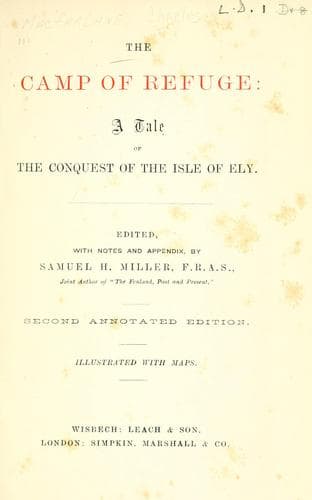
The Camp of Refuge: A Tale of the Conquest of the Isle of ElyMacFarlane, Charles
History
The Camp of Refuge: A Tale of the Conquest of the Isle of Ely
MacFarlane, Charles
Great Britain -- History -- Medieval period, 1066-1485 -- Fiction
plain where the ancient city of Troy once stood. This great cone was
not raised and shaped by nature. The common people, who will be for
ever betraying their ignorance, said that the devil had made it, for
some ridiculous purpose; but learned men opined that it had been raised
by the ancient Britons[168] for some purpose of defence, or as some
lasting monument to the great dead. When the Romans came and conquered
the country, they had made an entrenched camp round about this mound,
and had built a tower or guard-house upon the top of the mound; but
these works had either been destroyed by the Danes or had been allowed
to fall into decay and into ruin through the too great negligence of
the Saxons. Now from top of this green hillock, looking across rivers
and meres and flat fens, where the highest tree that grew was the
marsh-willow, a good eye could see for many miles and almost penetrate
into the recesses of the isle of Ely and the Camp of Refuge. The old
Roman road or causeway, called the Ermine[169] Street, which led into
the heart of the fen country, ran close under the mound and a little
outside the trenches of the Roman camp. Seeing all the advantages of
the spot, as a barrier for the defence of the country behind the Cam,
and as an advanced position on the side of the country, and as a place
of arms wherein might be collected the means of attacking the
indomitable Camp of Refuge, the Normans cleared out the broad ditches
which the Romans had dug, and which time and accident or design had
filled up, restored the double circumvallation of earthen walls or
embankments, erected a strong castle within, and raised the Julius, or
keep or main tower of the castle, upon the summit of the mound, where
the old Roman tower or guard-house had stood. They had not been allowed
to do all this work without many interruptions and night-attacks of the
daring people of the neighbouring fens, or by the bold Saxons who had
fled for refuge into the isle of Ely. But when the work was finished
the Normans boasted that they had bitted and bridled the wild Saxon
horse of the fens. For some time past knights, and men-at-arms, and
bowmen, and foot-soldiers, drawn from nearly every country in Europe to
aid the son of Robert the Devil in conquering the little island of
England, had been arriving at the entrenched camp and castle of
Cam-Bridge; whither also had come from the city of London and from
various of the towns and ports which had quietly submitted to the
strangers, great convoys of provisions and stores of arms and armour
and clothes; and all these aliens had been telling such of the English
people as could understand them, and had not fled from the town, that
they were going to assault the great house at Ely and the Camp of
Refuge, and hang all the traitors and rebels they might find there,
upon the willow trees. Nothing, however, could be undertaken in the
land of marshes and rushes until the rainy season should be over and
the waters somewhat abated.
Public-domain text, read in full here on John Shaqi.
Reviews
Reviews
No reviews yet
Be the first to share your thoughts on this work.
Elsewhere in the archive
Join the Discussion
Join the discussion
Sign in to leave a comment or review.
Sign InorCreate an account