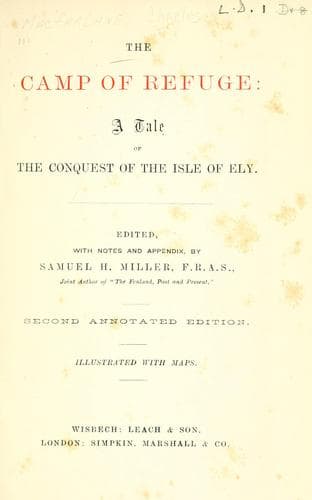
The Camp of Refuge: A Tale of the Conquest of the Isle of ElyMacFarlane, Charles
History
The Camp of Refuge: A Tale of the Conquest of the Isle of Ely
MacFarlane, Charles
Great Britain -- History -- Medieval period, 1066-1485 -- Fiction
Now it happened this year that the rains
ceased much earlier than was usual, and that the summer sun, as if
impatient for empire, began to rule and to dry up the wet ground long
before the season of spring was passed. There fell very little rain
after the quinquane of Pasche,[170] but after the feast of Saint
Walburga the Virgin there fell no rain at all, and the weather became
uncommonly dry and hot. It was pleasant to the eye to see the waters of
the Cam, the Ouse, the Welland, the Nene, the Witham, and the other
rivers retiring as it were into their natural beds, and flowing very
smoothly and clearly towards the great Wash; to see green meadows
re-appear where pools and meres had been, and flocks and herds
beginning to graze where boats and skerries and men walking upon tall
stilts had been seen but a few weeks before; to see, as far as the eye
could reach, a beautiful green prospect, with rich pastures, gliding
rivers, and adornments of woods and islands. But if this was pleasant
to the eye, it was not conducive to the security of the Saxon chiefs.
On the vigil of Saint Bede the Venerable, priest and confessor, which
falls on the twenty-seventh of the decades of May, Eustache of
Ambleville, a Norman captain of high repute, who had come over with
William and the first incomers, and had fought at the battle of
Hastings, arrived at Cam-Bridge with more soldiers, and with orders
from William to take the entire command of all the forces collected in
the camp and castle. Eustache was so confident of an easy victory that
he would not allow himself to think of the possibility of any defeat or
reverse. As he looked from the top of the keep towards Ely, he said,
triumphantly, “The waters are gone, and I am come. The Camp of Refuge
is no more! In three days’ time we shall be feasting in the hall of
this rebellious abbat, who hath so long defied us!” The other knights
that were to follow him in this adventure were just as confident as
Eustache of Ambleville, and the men-at-arms were already calculating
how they should divide the spoil that was to be made at Ely. Little did
they think how the shrine-boxes had all been emptied! Less still did
they think of the great loss of goods they themselves were going to
sustain!
Public-domain text, read in full here on John Shaqi.
Reviews
Reviews
No reviews yet
Be the first to share your thoughts on this work.
Elsewhere in the archive
Join the Discussion
Join the discussion
Sign in to leave a comment or review.
Sign InorCreate an account