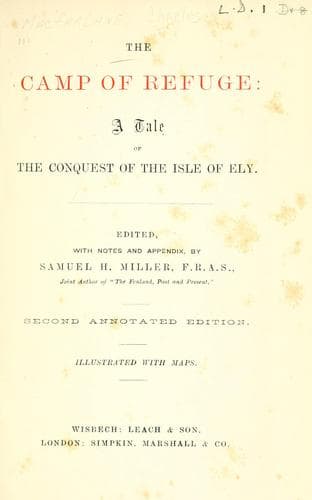
The Camp of Refuge: A Tale of the Conquest of the Isle of ElyMacFarlane, Charles
History
The Camp of Refuge: A Tale of the Conquest of the Isle of Ely
MacFarlane, Charles
Great Britain -- History -- Medieval period, 1066-1485 -- Fiction
Judge ye the wrath of that terrible false French abbat when he came to
the house at Peterborough, and heard and likewise saw all that had been
done! First he pulled at his own hair, and next he snatched at the
prior’s head and tore his hair away by handfuls. He would not believe
one jot of the tale that was told him about Hereward’s forcible entry
and seizures; he would believe nothing but that they were all in league
with the rebels and robbers of the fens, even as they had been when
Abbat Brand blessed the sword of Hereward and made him knight, and took
into his house a garrison of armed Saxons. The more they protested and
vowed, the more he disbelieved them; and this first conference between
these untrue Saxon monks and their choleric Norman abbat ended in
Torauld’s shouting, “Come hither, my men-at-arms, and fustigate these
liars!” And while the men-at-arms beat the commoner monks and the
lay-brothers of the house, Torauld himself tweaked the noses of the
superiors with his gauntleted hand, and drawing his heavy sword, he
applied the flat of it to the prior, the sacrist, the chamberlain, the
refectorarius, and all the rest of the officials, beating them all even
as he used to belabour his monks and novices in Normandie. But the true
English members of the house did not share in this pain and
humiliation, for the sub-sacrist and every one of them that was a good
Saxon had gone off with Lord Hereward more than an hour before. When he
grew tired of this his first hard lesson in ecclesiastical discipline,
Torauld caused the prior and the sacrist and every monk that had stayed
behind, to be thrown into the dungeon of the house, and there he kept
them two days and two nights without food and drink.
Some few of the new Lord Abbat of Peterborough’s men-at-arms thought,
that instead of fustigating the English monks, they ought to have
followed Hereward and the English soldiers, and have made an effort to
recover the good things they had carried off; but Torauld, who was bold
only where there was no chance of resistance, would not venture a
pursuit after an alert and most daring enemy into a difficult country;
and so he swore to his people that the Saxon robbers must have been
gone, not one, but more than three hours before his arrival; that
instead of counting sixty men, they were six hundred strong at the very
least. Whether they were sixty or six hundred, none of the men-at-arms
who knew anything concerning the fenny country were at all eager for
the pursuit, albeit they all imagined that the treasure which Lord
Hereward had carried off with him from the abbey was great enough to
pay for a king’s ransom.
Thus the new Norman Abbat and his unpriestly and ungodly men entered
upon possession of the ancient abbey of Peterborough: but feast that
day was there none.
CHAPTER XVII.
HEREWARD GOES TO BRUNN, AND IS DISTURBED THERE.
Public-domain text, read in full here on John Shaqi.
Reviews
Reviews
No reviews yet
Be the first to share your thoughts on this work.
Elsewhere in the archive
Join the Discussion
Join the discussion
Sign in to leave a comment or review.
Sign InorCreate an account