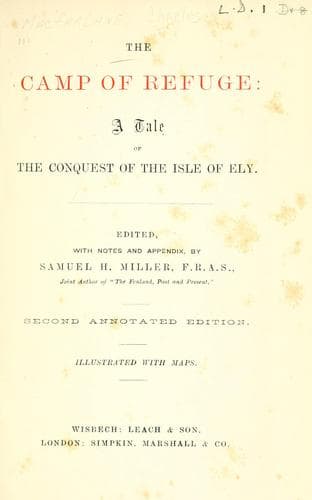
The Camp of Refuge: A Tale of the Conquest of the Isle of ElyMacFarlane, Charles
History
The Camp of Refuge: A Tale of the Conquest of the Isle of Ely
MacFarlane, Charles
Great Britain -- History -- Medieval period, 1066-1485 -- Fiction
Thus had the good Lord of Brunn triumphed on the land which he
inherited from his father and recovered with his own sword; thus within
the good manor of Brunn had he foiled the stratagems of his enemies,
and beaten them and humbled them, and made them the captives of his
sword: but he could not long remain to enjoy his triumph there; his
sword and his counsel were wanted in other parts; and deeming that the
unwonted dryness of the season might perchance enable Ivo Taille-Bois
or some other Norman lord to make another attempt upon Brunn, he took
his ladie with him whither he went. A small but trusty garrison was
left in the old manor-house, together with sundry matrons and maids,
but Mildred went with her ladie, as did Elfric with his lord.
As they came to the Welland, on their way to Ely, there came unto Lord
Hereward some brave men from the world beyond the fens, to tell him
that a great body of Saxon serfs had gathered together at the edge of
Sherwood forest and on the banks of the Trent, and that all these men
were ready to join him and become his servants and soldiers. Hereward
gave the messengers the encouragement they seemed to merit, and sent
his sword-bearer back with them to see what manner of men the band was
made of, and to bring them across the fens if he should find them worth
their bread and meat.
Now the men that had collected were hardy and fit for war, and many of
them, being natives to the forests and trained to hunting, were keen
bowmen. The Lord of Brunn, who knew the worth of the English bow, much
wanted good bowmen; and thus Elfric would gladly have brought away all
these foresters with him. But when the marching time came, sundry of
these churls said that they were well where they were in Sherwood:—and
for that matter so they were, for the Normans could not easily get at
them, and they were lords of the forest and of all the game in it, and
they robbed all that came near to the forest. But all the churls were
not so churlish, nor so fond of living without law and order, nor so
careless as to what became of their countrymen; and many were the good
bowmen that said they would go to the Saxon camp. Some of these upland
churls, however, who had not led so free a life as the fenners, and had
not had such good Lords as the Abbat of Ely and the Lord of Brunn,
began to say to the men of the hills that were following Elfric, that
they thought they were engaging in an idle chase and a very useless
struggle, inasmuch as they would still be all serfs and bondmen whether
the Normans or the Saxons ruled the land. But Elfric, hearing this,
bade them all remember that it was one thing to obey a Lord that spoke
their own tongue, and another to obey a stranger Lord who spoke it not
and despised it; that the good Saxon Lords were ever merciful and kind,
not putting more labour on the serf than the serf could bear, and
feeding and entertaining him well when sickness or when old age allowed
Public-domain text, read in full here on John Shaqi.
Reviews
Reviews
No reviews yet
Be the first to share your thoughts on this work.
Elsewhere in the archive
Join the Discussion
Join the discussion
Sign in to leave a comment or review.
Sign InorCreate an account