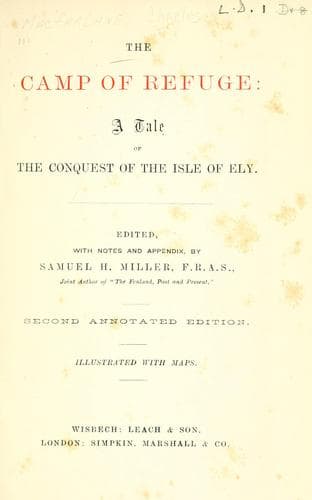
The Camp of Refuge: A Tale of the Conquest of the Isle of ElyMacFarlane, Charles
History
The Camp of Refuge: A Tale of the Conquest of the Isle of Ely
MacFarlane, Charles
Great Britain -- History -- Medieval period, 1066-1485 -- Fiction
him not to work at all; and that the good old Saxon laws and customs
did not leave the eyes, limbs, life, and conscience of the serfs in the
hands of their lords and masters, nor allow Christian bondmen to be
treated as though they were beasts of the field; in which fashion the
Normans were now treating them. Quoth a grey-beard in the crowd, “There
is some truth in what the young man saith. That was not a bad law which
said, ‘Let the churl keep the fasts of the church as well as the Lord,
and let the master that feeds his serfs on fast-days with meat, denying
them bread, be put in the pillory.’”
“Aye,” said another elder, smothing his beard, “but that was a still
better law which said, ‘Let not the serf be made to work on the
feast-days of the church, nor to do any manner of work on the Sabbath:
Let all have rest on the seventh day, which is the day of the Lord
God!’”
Here one who had been a mass-priest in the upland country, but who had
fled from the intolerable persecutions of the Normans and was now armed
against that people, spoke as one that had tasted books, and said,
“Many were our good old Saxon laws for keeping holy the Sabbath-day,
and making the seventh day a day of rest for all that live in the land,
whether rich or poor, master or slave. The fourth commandment, which
the Normans set at nought in as far as the poor English serf is
concerned in it, was a most binding law with all good Saxons, and was
enforced by many royal laws and civil enactments, and with the imposing
of penalties upon all such as broke the commandment. The laws and
ordinances of King Edward the Elder said—‘If any one engage in Sunday
marketing, let him forfeit the goods and pay a fine of thirty
shillings. If a freeman work, let him forfeit his freedom, or redeem it
by paying wite[184]; if a Lord oblige his churl to work, let him pay
wite.’ And, after this, King Athelstane said in his dooms ‘that there
should be no marketing and no labour on Sundays, and that if any one
did market on Sundays he should forfeit the goods and pay thirty
shillings.’ And, after this, King Ethelred said in his dooms, ‘Let
Sunday’s festival be rightly kept by _all_, as is becoming, and let
marketings and folkmotes be carefully abstained from on that holy day;
let huntings and worldly works be strictly abstained from on that day.’
And by the laws of King Edgar no man was to work from noontide of the
Saturday till the dawn of Monday; and soulscot[185] was to be paid for
every Christian man to the priest, in order that the priest might pray
for him and instruct him. And the canons[186] of Ælfric, inhibiting the
breach of the sanctity of the Lord’s day, say, ‘The mass-priests shall
on Sundays explain to the people the sense of the Gospels in English,
and explain to them in English the pater-noster and the creed, to the
end that all the people may know the faith and cultivate their
Christianity.’ And in this very canon the pious Ælfric saith, ‘Let the
Public-domain text, read in full here on John Shaqi.
Reviews
Reviews
No reviews yet
Be the first to share your thoughts on this work.
Elsewhere in the archive
Join the Discussion
Join the discussion
Sign in to leave a comment or review.
Sign InorCreate an account