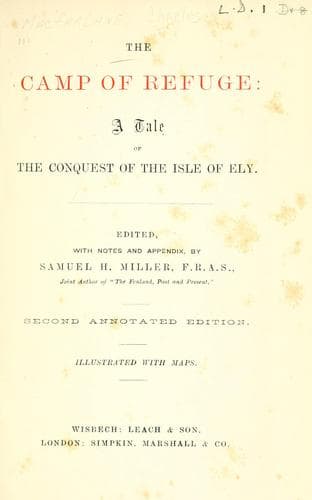
The Camp of Refuge: A Tale of the Conquest of the Isle of ElyMacFarlane, Charles
History
The Camp of Refuge: A Tale of the Conquest of the Isle of Ely
MacFarlane, Charles
Great Britain -- History -- Medieval period, 1066-1485 -- Fiction
priest and teacher beware of that which the prophet said; _Canes muti
non possunt latrare_, Dumb dogs cannot bark!’ But what are these Norman
teachers and priests from beyond the sea but dumb dogs to the Saxon
people, seeing they know no English and will not learn it?”
“Yes,” said the ancient who had first spoken, “until these Normans came
among us the bondman had one day in seven to himself, and on every
other festival of the church he was allowed to forget his bonds, and to
take rest and enjoyment, and to think of his soul; but now we be
treated as if we had no souls.”
“And,” said another of the serfs, “in former days the laws protected
the money and goods of a bondman, if so be he could obtain any, for the
Saxon law said that the master must not take from his slave that which
the slave had gained by his industry. But now the serf cannot so much
as call his life his property.”
“Nor can any other true Saxon call anything his own, unless he stand up
and fight for it, and prove strong enough to keep it,” said Elfric, who
was well pleased to see and hear that his discourse on the difference
between the old bondage and the present was not thrown away upon the
upland serfs.
Quoth the priest who had before spoken, “Our old Saxon laws were chary
of blood, and held in tender respect the life of all men, whether they
belonged to the nobility or were in a state of villainage. Few crimes
were punished with death or even with mutilation. The commandment that
man shall do no murder was not only read in churches, but was
recommended and enforced in the laws and dooms of many Saxon kings. ‘If
any one be slain,’ said the old law, ‘let him be paid for according to
his birth.’ If a thane slew a churl, he had to pay for it....”
“Aye,” said one of the serfs, “but the value of the life of a churl was
not more than the price of a few bullocks; whereas hides of land or the
worth of hundreds of bullocks was to be paid by him that slew a thane.”
“Tush!” quoth Elfric, “thou canst not expect that the life of a churl
can ever be priced so high as that of a noble, or that the same doom
shall await the man that kills a Lord and the man that kills a peasant!”
The priest and all the bystanders said that such an expectation would
be too unreasonable, and that such a thing could never come to pass in
this world: and so the discontented churl merely muttered that he
thought, since it was allowed the churl had an immortal soul, even as
the thane, that the life of a churl was worth more than a few bullocks;
and then said no more about it, bethinking himself that even that price
was better than no price at all, and that no Normans that he knew of
had ever yet been made to make bot for maiming or killing a Saxon serf.
Public-domain text, read in full here on John Shaqi.
Reviews
Reviews
No reviews yet
Be the first to share your thoughts on this work.
Elsewhere in the archive
Join the Discussion
Join the discussion
Sign in to leave a comment or review.
Sign InorCreate an account