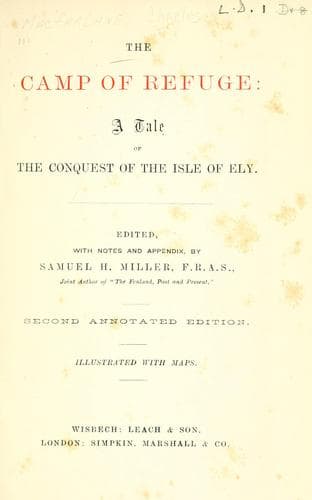
The Camp of Refuge: A Tale of the Conquest of the Isle of ElyMacFarlane, Charles
History
The Camp of Refuge: A Tale of the Conquest of the Isle of Ely
MacFarlane, Charles
Great Britain -- History -- Medieval period, 1066-1485 -- Fiction
Some few of these men returned into Sherwood forest, to live at large
there, but the major part of them tied on their buskins, fastened their
sheep-skin jackets, put their bows and quivers to their backs, and
marched off merrily with the sword-bearer to join Lord Hereward at Ely
or in the Camp. And after this, and at various times, many upland
churls, discontented with their lot, came from the northern side of the
Trent and from other parts of the country to join the Saxon army in the
fens. It must not be thought that the Lord of Brunn was unmindful of
the old laws, which ordained that no Lord or free man should harbour or
entertain the churl that had fled from his rightful owner; but Hereward
felt that no Norman could have the right of property over Saxon serfs;
and therefore he harboured and entertained such as came freely to him.
If the case had been otherwise, he would, like the just Lord that he
was, have put collars and chains upon the serfs and have sent them back
to their masters.
CHAPTER XVIII.
THE DANES AND THEIR KING’S SON.
Svend Estrithson sat upon the throne of Danemarck, and was a powerful
king and a great warrior, having fought many battles by sea against his
neighbour the King of Norway. When his brother Osbiorn Jarl abandoned
the Saxons and returned from England into Danemarck, Svend Estrithson
was exceedingly wroth at him, and his anger was the greater because the
Jarl had not only lost the treasure which William the Norman had given
him as the price of his treasons to the English people, but had lost
likewise nearly the whole of the Danish fleet; for a great storm arose
at sea and swallowed up most of the two hundred and forty returning
ships.[187] Osbiorn Jarl escaped drowning; but when he presented
himself before the face of his brother the king, Svend loaded him with
reproaches, deprived him of his lands and honours, and drove him into a
disgraceful banishment.[188] Even thus was bad faith punished, and
vengeance taken upon the Danes for that they had both plundered and
betrayed the Saxon people, who were fighting for their liberties
against the Normans.
Public-domain text, read in full here on John Shaqi.
Reviews
Reviews
No reviews yet
Be the first to share your thoughts on this work.
Elsewhere in the archive
Join the Discussion
Join the discussion
Sign in to leave a comment or review.
Sign InorCreate an account