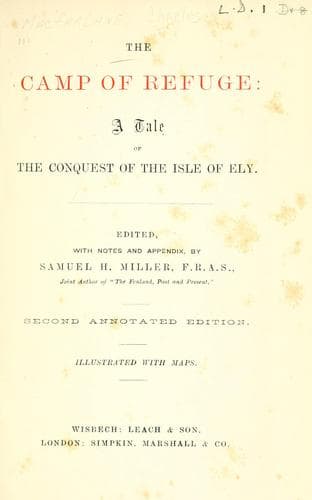
The Camp of Refuge: A Tale of the Conquest of the Isle of ElyMacFarlane, Charles
History
The Camp of Refuge: A Tale of the Conquest of the Isle of Ely
MacFarlane, Charles
Great Britain -- History -- Medieval period, 1066-1485 -- Fiction
Svend Estrithson, being of the line of the great King Canute,[189]
raised some claim to the throne of England, and had ever considered his
right better and more legal than that of William of Normandie. Before
the arrival at his court of the earnest invitation of the monks of Ely
and the great Saxon lords in the Camp of Refuge, he had resolved in his
own mind to try his fortune once more on our side the sea, hoping that
if he should do no more he should at least be enabled to make up for
the loss of his great fleet, a loss which pressed heavily upon his
heart, and destroyed his peace by day and his rest by night. He had
summoned his jarls and chiefs, the descendants of the sea-kings or
great pirates of old, and had taken counsel of the old sea-rovers and
warriors who had been in England with the great Canute, or who had
served under Canute’s sons, King Harold Harefoot and King Hardicanute.
Now these jarls and chiefs, together with many of their followers, were
well acquainted with all the eastern side of England from the Scottish
border to the end of Cornwall; and they knew every bay, harbour, and
creek on the coast, and all the deep inlets of the sea and the rivers
which gave access to the interior of the country, for they had warred
or plundered in them all, aforetime. Being called upon by King Svend to
give their advice, these chiefs and nobles all said that another
expedition ought to be attempted without loss of time; and it was
agreed at a great meeting of the Viborgting, which corresponds with the
Witangemot of old England, that another great fleet should be got
ready, and that the king or his eldest son should take the command of
it. Some doubts, however, occurred as to the present strength of the
Normans and the present condition of the English; and, although they
meant to betray them or conquer them themselves, the Danes proposed to
begin merely as allies of the English,[190] and felt little good could
be done unless the English on the eastern coast were unsubdued by the
Normans, and ready to receive the Danes with open arms. At this
juncture a ship arrived from Lynn with the envoy from the Camp of
Refuge on board. As soon as the Englishman had presented the letters
and the gold and silver he brought to Svend Estrithson, the king called
together his great council. The envoy from the Camp of Refuge was
allowed to speak at great length before the council, and the shipmen of
Lynn were more privately examined touching the present situation of
affairs in the fen country. All doubts were removed, and the fleet was
forthwith ordered to get ready for the voyage to England. Already many
thousands of long and yellow-haired warriors had been collected for the
enterprise, and now many thousands more flocked towards the fleet from
all parts of Jutland, Zealand, and Holstein, and from Stralsund and the
Isle of Rugen, and the other isles that stand near the entrance of the
Baltic Sea; for whenever an expedition to the rich and fertile country
Public-domain text, read in full here on John Shaqi.
Reviews
Reviews
No reviews yet
Be the first to share your thoughts on this work.
Elsewhere in the archive
Join the Discussion
Join the discussion
Sign in to leave a comment or review.
Sign InorCreate an account