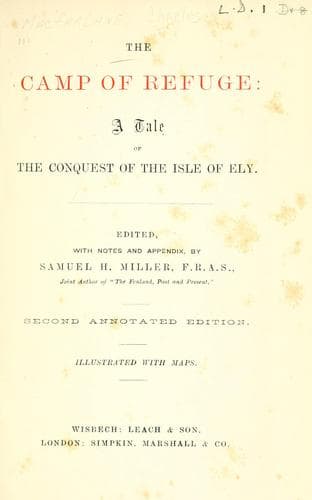
The Camp of Refuge: A Tale of the Conquest of the Isle of ElyMacFarlane, Charles
History
The Camp of Refuge: A Tale of the Conquest of the Isle of Ely
MacFarlane, Charles
Great Britain -- History -- Medieval period, 1066-1485 -- Fiction
from feeling assured, and save one or two, that were afterwards proved
to be false traitors in their hearts, they all returned to Ely sadder
men than they were when they left it to go to meet Knut.
That which the white-headed sea-rover had said, and a great deal more
than he uttered, speedily came to pass: north and south the English
coast was plundered; and, ascending the many rivers in their lighter
vessels and in their boats, the Danes went far into the interior of the
country, pillaging, burning, and destroying, even as their forefathers
had done in the heathenish times. Up the broad Humber they went until
they got into the Yorkshire Ouse, and they would have gone on to the
city of York, but that it was strongly garrisoned by Normans, and the
whole country a desert—a desert which Osbiorn and his evil company had
made in the preceding year. On the river Yare they went as high as the
good city of Norwich, but they ventured not to attack the Normans in
that place.[195] The Waveney, too, and the Ald they visited, nor left
the poor Saxons there so much as a fishing-boat. Up the river Deeben as
far as the wood bridge, where a pleasant town hath since risen; and
between the pleasant, green-wooded banks of the Orwell, they sailed
many a league. After ravaging the banks of the Stour, Knut collected
all his ships together and then spread his sails on the smooth Medway
and the broad Thamesis, going up the Thamesis almost to London; and
then mooring his ships, and making a great show as though he intended
to land an army and lay siege to the Tower of London, which the Normans
were then busily enlarging and strengthening.
Not all the doings of the Danes, and the robberies and cruelties they
committed upon poor defenceless Saxons, could be known in the Camp of
Refuge; yet enough was known by the report of the country people to
grieve every English heart in the camp, and to confirm the worst
suspicions which Abbat Thurstan had conceived. On the other hand, it
was made apparent that the Normans were greatly distracted by this new
invasion, and that, while their vicomtes and knights and men-at-arms
were marching in almost every other direction, none of them came near
to the last asylum of Saxon liberty. In truth, the posts which had
previously been drawn round the fen country were so far weakened that
the Lord Hereward, who had again taken a direct and entire command in
the Camp of Refuge, made several good sallies from the fens and brought
back not a few Norman prisoners, together with good store of provision.
Public-domain text, read in full here on John Shaqi.
Reviews
Reviews
No reviews yet
Be the first to share your thoughts on this work.
Elsewhere in the archive
Join the Discussion
Join the discussion
Sign in to leave a comment or review.
Sign InorCreate an account