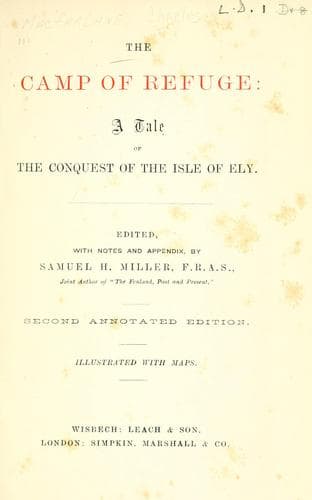
The Camp of Refuge: A Tale of the Conquest of the Isle of ElyMacFarlane, Charles
History
The Camp of Refuge: A Tale of the Conquest of the Isle of Ely
MacFarlane, Charles
Great Britain -- History -- Medieval period, 1066-1485 -- Fiction
willows and alders, and falling upon the workmen and destroying their
works. On several occasions he cut the Norman guard to pieces before
they could form in order of battle; and several times he destroyed in a
single night the labour of many days, levelling the Norman towers with
the ground, breaking up their bridges, and carrying off their timber
and their tools and other good spoil. It always happened that when his
enemies were surest he would not come, he came; and when they expected
him at one given point, he was sure to make an attack upon another and
distant point. At times his ambuscades, surprises, and onslaughts were
so numerous and rapid that he seemed to have the faculty of being in
many places at one and the same time. Many a Norman knight was
surprised at his post, or even carried off from the midst of a camp,
and dragged through the rushes and forests at the dead of night, an
astounded and helpless captive. Many a time a great body of Norman
troops would take to flight and leave all their baggage behind them,
upon merely hearing the shout of “Hereward for England!” or those other
shouts, “The Lord of Brunn is coming! Fly, ye Norman thieves! Out!
out!” Such were Lord Hereward’s successes, and such the Norman awe of
his unforeseen stratagems and unaccountable surprises, that the Normans
entirely believed Hereward to be in league with the devil, and to be
aided by witches and necromancers and fiends worse than the blubber
devils of Crowland. Now it was true that, for many of his stratagems
and devices, and for many of the sleights and tricks with which he
appalled the Normans, Hereward was indebted to the science and travail
of that thin, dark man of Salerno and Norman-hater, Girolamo; and, by
means of deserters from the camp, and by means of ransomed Normans that
had been allowed to quit the camp, the Salernitan, if he had not been
made well known to the Normans, had been much talked about, and had
become the object of so much dread that no knight or man-at-arms ever
named his name without crossing himself. Nor were the Normans long
before they agreed, one and all, that the dark and silent Salernitan
was Hereward’s chief magician, the devil-dealing necromancer to whom he
stood indebted for all his successes. Loudly did they raise their
voices against this supposed wickedness; and yet, when they found that
their misfortunes and losses went on increasing, they came to the
resolution to meet what was no witchcraft at all with real witchcraft,
and they told Duke William in Cam-Bridge Castle that he must send over
into Normandie for the most famed witch of that land, where there was
no lack either of witches or of warlocks; and the son of Robert the
Devil, whose father, as his name imports, had been liege man to
Lucifer, sent over to Normandie accordingly to seek for the most
dreaded of Norman witches. Now, whether it was this wickedness that did
it, or whether it was that the moist air of the fens and the autumnal
Public-domain text, read in full here on John Shaqi.
Reviews
Reviews
No reviews yet
Be the first to share your thoughts on this work.
Elsewhere in the archive
Join the Discussion
Join the discussion
Sign in to leave a comment or review.
Sign InorCreate an account