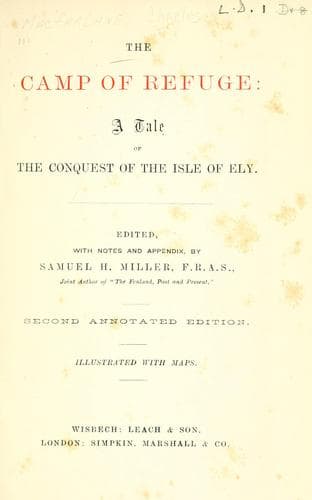
The Camp of Refuge: A Tale of the Conquest of the Isle of ElyMacFarlane, Charles
History
The Camp of Refuge: A Tale of the Conquest of the Isle of Ely
MacFarlane, Charles
Great Britain -- History -- Medieval period, 1066-1485 -- Fiction
Many were the bold essays which the Lord of Brunn made to break up this
blockade. Twice, descending the Ouse, or the Welland, with the barks he
had stationed at Ely, and near to Spalding, he defeated and drove away
the enemy’s ships, and burned some of them with that unquenchable fire
which the Salernitan knew how to make; but after these actions the
Normans and their shipmen became more watchful and cautious, keeping
outside of the mouths of the rivers, and continuing to increase their
force; for other ships and barques, both great and small, came over
from Normandie, and others were hired for this service among the
sea-dwelling Netherlanders, who seemed evermore disposed to serve
whatever faction could pay them best. And alas! the Normans had now
their hands in the great and ever-filling treasury of broad England,
and the true sons of England, whether at Ely or in the Camp, had no
longer any gold or silver! or any means of sending forth that which can
bring back money or the money’s worth. Horned cattle had they still in
some abundance, nor was there, as yet, any scarcity in sheep, or in
wool, or in hides; but of corn to make the bread, which is the staff of
life, and of wine, which maketh glad the heart of man, was there little
or none left in this part of the land; forasmuch as that the
Fen-country did not grow much corn at any season, and the last season
had been one of dearth, and only a few butts of wine had been brought
over since the departure of the Danes, owing to the lack of money above
mentioned. Those sea-rovers, having drunk almost the last drop of wine
as well as carried off the last treasures of the house, had greatly
disheartened and troubled many of the monks of Ely, and murmurs, and
censures, and base thoughts now began to rise among several of the
cloister-monks who, down to this evil time, had been the steadiest
friends of the Lord Abbat, Thurstan. Truly, truly, their trial was
hard, and difficult for true Saxon stomachs to bear! The octaves of
Saint John had come and passed without anything that could be called a
feast: on the day of Saint Joseph of Arimathea they had no wine to
drink, and on the day of that high Saxon saint, Osevald, king and
martyr, they had no bread to eat with their roast meats. These were sad
things to a brotherhood that had been wont to fare so well, and whose
feasts, it hath been said by our old poet (a monk of the house), were
as superior to the feasts of all the other monasteries of England as
day is superior to night:—
Prævisis aliis, Eliensia festa videre
Est, quasi prævisâ nocte, videre diem.
Public-domain text, read in full here on John Shaqi.
Reviews
Reviews
No reviews yet
Be the first to share your thoughts on this work.
Elsewhere in the archive
Join the Discussion
Join the discussion
Sign in to leave a comment or review.
Sign InorCreate an account