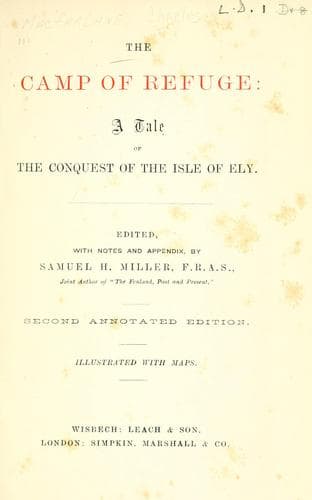
The Camp of Refuge: A Tale of the Conquest of the Isle of ElyMacFarlane, Charles
History
The Camp of Refuge: A Tale of the Conquest of the Isle of Ely
MacFarlane, Charles
Great Britain -- History -- Medieval period, 1066-1485 -- Fiction
Yet the bountiful Abbat Thurstan, who had given the best feasts of all
that the house had ever known, and who loved as much as any man to see
the drinking-horn go round, kept up his good spirit without wine—it
was sustained by his generous love of country and liberty!—and he
reasoned well with those he heard murmur, and yet held out to them the
prospect of better times when corn should come in from the upland
country in abundance, and good wine from beyond-sea.
If want began to be felt among the monks of Ely, it is not to be
believed but that it was felt still more sharply among the Saxon
fighting men collected in the Camp of Refuge. But the stomachs of these
warriors were not so dainty as the stomachs of the monks, and the
commonalty of them, being accustomed to fare hard before now, made no
complaint. Alas, no! It was not through the malecontent of these rude
men, nor through these lay stomachs, but through the malice and
gluttony of cloister-monks, that the sanctuary was violated.
The Lord of Brunn having emptied his own granaries and cellars for the
behoof of the house at Ely, made sundry very desperate forays, breaking
through the Norman chain of posts, and going far in the upland country
in search of supplies, and risking his noble life, more than once, for
nought but a sack of wheat, or a cask of ale, or a firkin of mead.
While the blockade was as yet young, a few devout pilgrims, who would
not be shut out from the shrines of the Saxon saints at Ely, nor fail
to offer up their little annual offerings, and a few sturdy friends who
knew the straits to which the monks were about to be reduced, eluded
the vigilance of the Normans, and found their way, through those mazes
of waters and labyrinths of woods, to the abbey, and carried with them
some small supplies: but as time went on and the force of the Normans
increased as well by land as by water, these hazardous journeys were
stopped, and divers of the poor Saxons were caught, and were then
pitilessly hanged as rebels and traitors; and then a law was banded
that every man, woman, or child, that attempted to go through the
Fen-country, either to Ely Abbey or the Camp of Refuge, would be hanged
or crucified. But, alack! real traitors to their country were
afterwards allowed to pass the Norman posts, and go on to Ely Abbey,
and it was through their agency and the representations of some of the
Normans that were taken prisoners in war and carried to the monastery,
that the envious prior, and the chamberlain, and the cellarer, and the
rest of that foul faction were emboldened to raise their voice publicly
against the good Abbat, and to lay snares in the path of the Lord of
Brunn. Now the same troubles arose out of the same causes in Crowland
Abbey, where sundry of the cloister monks began to say that since they
could get no bread and wine it were best to make terms with the Norman
Abbat of Peterborough (that Torauld of Fescamp who had been released
Public-domain text, read in full here on John Shaqi.
Reviews
Reviews
No reviews yet
Be the first to share your thoughts on this work.
Elsewhere in the archive
Join the Discussion
Join the discussion
Sign in to leave a comment or review.
Sign InorCreate an account